
Can we use alpha particle exposures to falsify LNT?

This post is a no fun read and a bit of an insider argument. Choir members are free to sleep through this sermon.
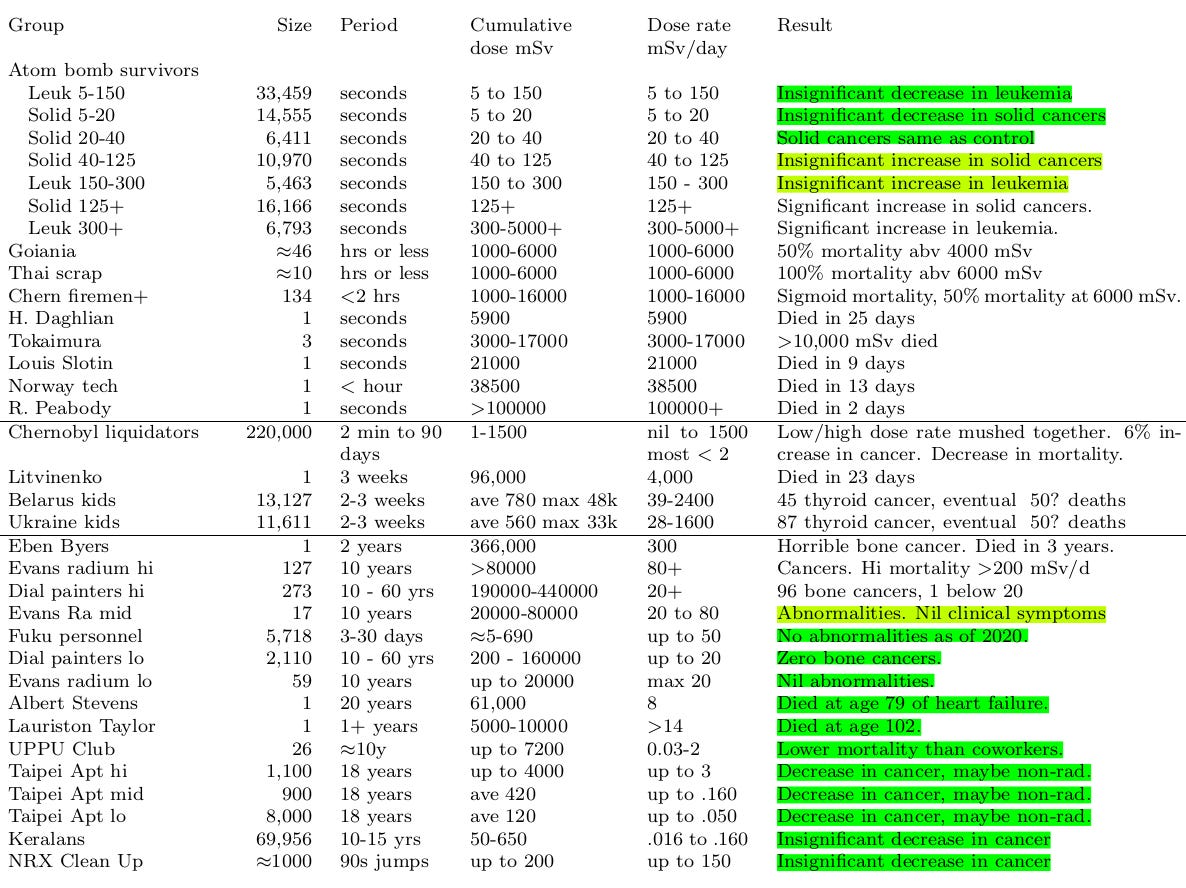
Table 1. The Green Table. Acute exposures above the top line. Chronic exposures below the bottom. If a dose is received all at once, we start to see cancer at about 100 mSv. But if the dose rate is kept below 20 mSv/d, we have not reliably detected cancer even when the cumulative dose is 100,000 mSv. If LNT were true, only the three bottom lines could be in the green.
In the last post, we showed that combining linear damage with proportional repair doe not necessarily mean that cancer incidence is linear in total dose. On the contrary, if closely spaced Double Strand Breaks (DSB) are the main cause of cancer from DNA damage, for which there is considerable evidence, that combination implies a quadratic or higher exponent in the low end dose response. That proposition, known as the Double Double Strand Break (DDSB) theory, is plausible but not proven. The bare fact that the combination of linear damage and proportional repair does not imply LNT, does not in itself invalidate LNT. To do that, we must combine the biology with some data,
Our DNA repair system is designed to handle DNA damage rates (DSB production) that are 25,000 to 125,000 times higher than the damage rate from average background radiation. This means we must concoct or find situations where animals or humans have been exposed to very large dose profiles, both high dose rate and low, to reliably see the effects of radiation. Otherwise the signal to noise ratio is just too small to separate the effects of radiation from the myriad of confounding factors. At near average background dose rates, it is impossible to falsify any semi-reasonable model. On the plus side, a single solid counter-example destroys any scientific hypothesis. In the case of LNT, we have a number of such “ugly facts”.
The Green Table, Table 1, lists most of the very large dose human exposures for which we have data. The overall pattern is clear. If a large dose is received at a very high dose rate, we start to see a significant increase in cancer at a total dose of between 100 and 300. But if the dose rate stays below about 20 mSv per day, we have not reliably detected cancer even when the cumulative dose is over 100,000 mSv. This ugly fact invalidates LNT, which claim claims cancer incidence is linear in cumulative dose.
Ken Chaplin, our resident Red Team, challenges this conclusion. He points out it is based in part on the ICRP RBE which is a fudge factor for converting grays to sieverts. Ken correctly calls the RBE an ugly kluge, Worse, the method by which the ICRP came up with an RBE of 20 for alpha particle exposure, which is what the dial painters and Radithor drinkers suffered, assumes LNT, which we claim is false.
But Ken goes way too far in claiming there is no useful relationship between alpha and photon exposure. The key is to separate the problem into two stages, which the ICRP does not do:
1) DNA damage, production of Double Strand Breaks (DSB)
2) DSB repair or cell disposal.
DNA damage is not harm. Harm, cancer incidence, results from misrepaired DSB’s. The bulk of the DNA damage is caused by chemically disruptive molecules, called Reactive Oxygen Species or ROS. The DNA molecule takes up about 3% of the cell’s volume. The cross-section that the molecule presents is roughly 5% of the cell’s cross-section. Something like 95% of the particles don’t hit the DNA helix; but they hit something, and that hit produces multiple ROS, which then chemically attack the DNA.
The DNA can’t know what type of particle produced the ROS. If most of the DSB’s are from the ROS, one can make a strong argument that the number of DSB’s produced should be linear in the energy absorbed since almost all the energy is absorbed in creating ROS. And in fact that’s what we see, Figure 1, over a very wide range of energy.
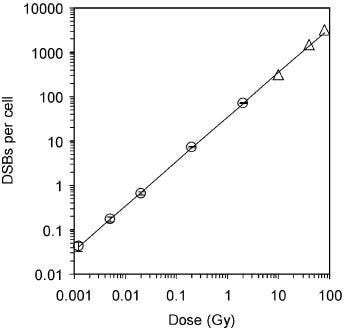
Figure 1. DSB’s/Gy. Line has a slope of 0.035 DSB/mGy.\cite{rothkamm-2003}[Fig 2] If direct hits on the DNA helix were important, we’d be keeping track of the number of particles, not their energy.
The only difference between photon and alpha exposures is the spatial distribution of the DSB’s. And it’s a big difference. All the energy in an alpha particle decay is deposited into the a small handful of cells in the immediate vicinity of the emitter.1 Photon energy is sprayed over a far wider area, often extending all the way across the body. But in both cases, the same amount of absorbed energy produces the same, or nearly the same, amount of DSB’s. The difference is in the misrepairability.
So how did the ICRP come up with a factor of 20 for the difference in misrepairability? That’s hard to say. The official ICRP document on the subject is Publication 92.\cite{icrp-2003} Pub 92 is a meandering, impenetrable collection of buzz words and acronyms. It is infested with conflicting numbers and content free sentences. But the number 20 goes back to Brooks’ 1975 comparison of the number of dicentric chromosomes produced by alpha emitters versus that by photon emitters.\cite{brooks-1975} At the end of the day, they simply chose to stick with the old number. They pointed out that any change would tighten or loosen existing regulations.\cite{icrp-2003}[p 101] For defenders of the status quo, that’s a no-no.
Ken asks what do dicentrics have to do with cancer? And in a historical sense he’s right. As far as I can tell this aberration was originally chosen simply because dicentrics can be seen and counted with an ordinary microscope, But I think they stumbled on a meaningful proxie for double DSB’s.
In a normal chromosome, the two strands cross at a single point, called a centomere. Dicentric chromosomes have two centomeres. They are formed when two DSB’s on different chromosomes are misrepaired by rejoining the wrong ends, Figure 2. This can only happen if the two DSB’s are very close to each other. So the number of dicentrics is a measure of how localized the damage is. But localized damage is also what causes closely spaced DSB’s on the same chromosome.
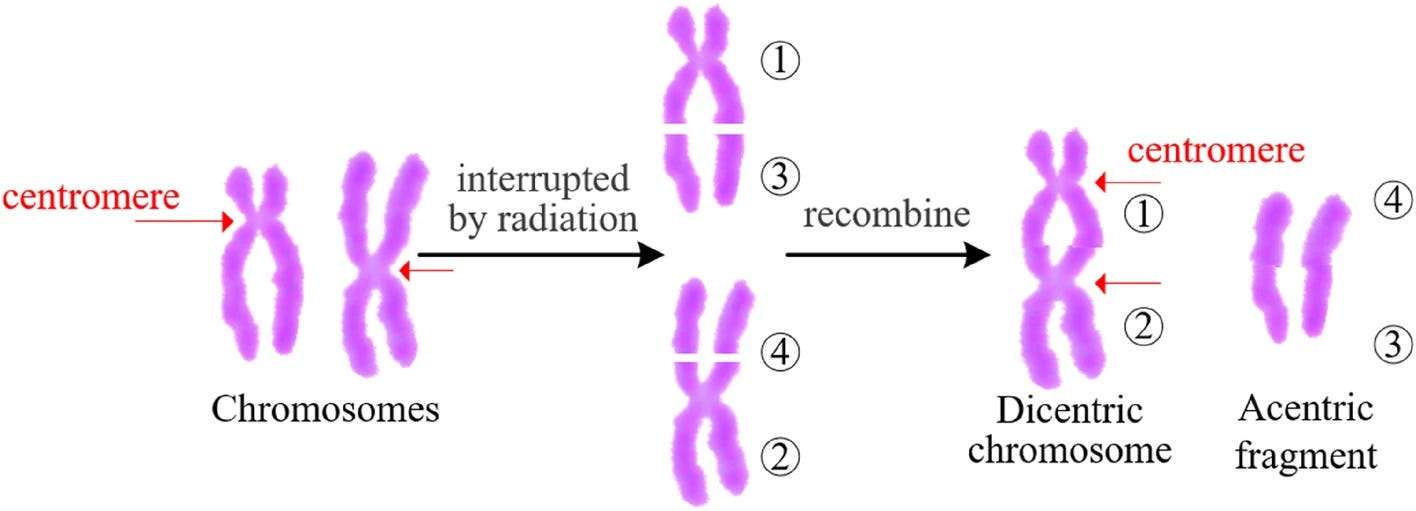
Figure 2. Dicentric formed be misrejoining two DSB’s
In short, there is good reason to believe that dicentrics are a useful, if far from perfect, indicator of the number of double DSB’s. And we have good reason to believe that double DSB’s are a main, if not the main, cause of cancer,
Of course, you can dispute the number 20. Brooks’ analysis of his data was based on LNT. He mixed differently shaped dose rate profiles indiscriminately. Only an LNTer can do that. But it is impossible to dispute the fact that, if you have two identical dose rate profiles in grays (energy/tissue), the alpha profile will produce a lot more cancer than the photon. This was known before Brooks, when the RBE was 10. It has been confirmed over and over again since. I know of no counter-examples.
The Green Table uses the ICRP RBE. But even if you were to reduce the RBE by a factor of ten, LNT is convincingly falsified; and the pre-1950 tolerance dose rate of 2 mSv/d stands.
Ken Chaplin is not an LNTer. He is free to espouse any radiation harm theory he wishes. But an LNTer can’t say: you can’t use alpha exposures to test LNT, without tearing down the whole LNT edifice. If he claims LNT applies only to non-alpha exposures,
1) he is denying 75 years of nuclear establishment claims and practice,
2) he must tell us why LNT applies to photon and electron radiation but not alpha radiation,
As far as I know, no LNTer has been willing to do that. And with good reason. There is nothing qualitatively different about alpha radiation DNA damage. A double strand break is a double strand break. There is a big difference in the spatial distribution of the damage, and that makes a difference in cancer incidence. But that does not mean we cannot use alpha exposures to test LNT. In fact, since alpha produces more cancer per gray, it is a stronger test.
This means that alpha particles have no penetrating power. Externally emitted alphas will not penetrate the outer dead layer of our skin. They will do no harm to the body. Alpha emitters must be ingested or inhaled in order to produce any harm. This has extremely important implications for handling spent nuclear fuel. Aged spent fuel must be swallowed to be a problem. It’s just another poison.
I made it to the end, not too bad. I guess I am an outlier in the choir!
This makes sense from my point of view, someone with 40 years working at nuclear power plants.
LNT and ALARA need to be replaced by something more reasonable, like SNT as advocated by our highly educated author.
Excellent description of the DNA damage process. I too had been wondering about the difference between direct damage and damage via ROS.
A bit off topic, but I have to quibble with your statement "the signal to noise ratio is just too small to separate the effects of radiation from the myriad of confounding factors. At near average background dose rates, it is impossible to falsify any semi-reasonable model."
I believe the Lung Cancer vs Radon data does exactly that, and actually provides one of the more understandable falsifications of LNT. (The jury will believe scatterplots over statistical sophistry from even the most prestigious expert.)
With enough data, you CAN separate the confounding factors. I won't fill this space with the entire analysis, but please have a look at my initial draft.
https://docs.google.com/document/d/1bTrkJSvrq-hzHaiE5WJBcPZOdkUoLHJb7Y3p13BLyUw/edit?tab=t.0#heading=h.54fwqtl8kxaw
We can rule out the most obvious confounder - smoking. The one variable, elevation, which DOES show some correlation with radon, goes the wrong way for LNTers. Counties with higher elevation have LESS lung cancer, the opposite of what must happen if we believe in LNT.