
Dunkelflauten Clusters (aka Winter)

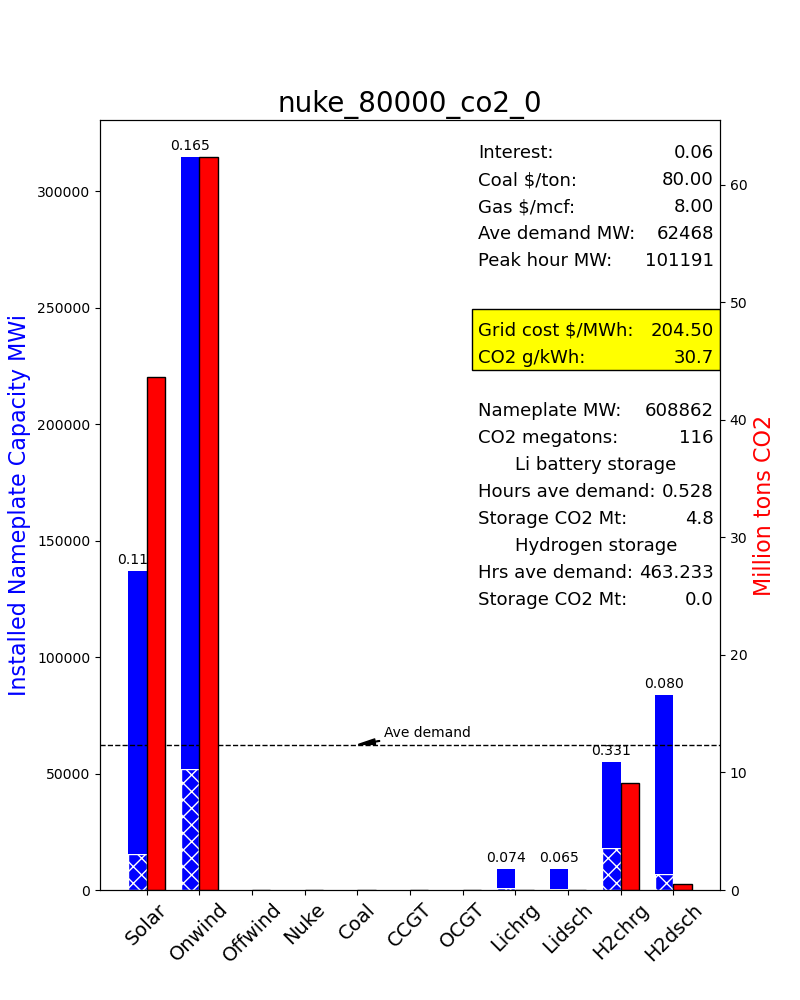
Figure 1. Optimal pure wind/solar/battery/hydrogen grid for Germany. Blue bars are installed capacity. Hatched area shows portion of capacity actually marketed. Red bars show CO2 emissions.
Nukies spend far too much time bashing wind/solar, when they should be bashing tragically over-priced nuclear. The Gordian Knot News tries to avoid this distraction from the real problem. But the current situation in Germany deserves a little attention.
People have slowly come to the realization that average capacity factor is a nearly meaningless number for intermittents if your goal is a reasonably reliable grid. Attention has turned to dunkelflauten.1 A dunkelflaute (dark lull) is a period of low wind and solar. Less poetically, meteorologists know them as anticyclonic glooms, a combination of a large high pressure area with a temperature inversion that traps all the moisture at the bottom of the inversion, forming a low cloud layer. Solar heating of the top of the clouds just makes thing worse. Dunkelflauten are common in northern Europe during the winter.
Worse, dunkelflauten tend to cluster. If overall weather conditions are unusually favorable for the formation of a dunkelflaute this week, a dunkelflaute is more likely than normal to form next week. This is a problem for grids that use excess wind/solar capacity to store energy for future use. Net Zero models that are based on some sort of “representative” year, which is almost all of them, cannot capture this behavior. For that you need an hour by hour model based on real world data.
The GKG grid Linear Program (LP) is such a model. However, the GKG model is biased in favor of wind/solar. For one thing, the GKG grid program is a single point model. There are no transmission costs. This is sometimes called a copper plate model. This assumption is heavily biased in favor of sources that are locale dependent. In Germany’s case most of the wind is in the far north of the country. What sun she has is concentrated in the south. The plan is to build 17,000 km of North-South high voltage lines But ten years on, only 3,350 km have been completed. Another 4,530 have been approved of which 780 are under construction. It’s not clear how much of the remaining 8000 km will ever be built. An order of magnitude estimate of the cost is 85 billion USD, about 2 cents per kWh. A should-cost nuclear based grid would have a total cost of around 5 cents per kWh (and less CO2).
I have compounded this by making some very optimistic assumptions about hydrogen generation and storage, basically accepting manufacturer claims for stuff that has never been built at scale.
Table 1 shows the model’s results for a pure wind/solar/battery/hydrogen grid for Germany.
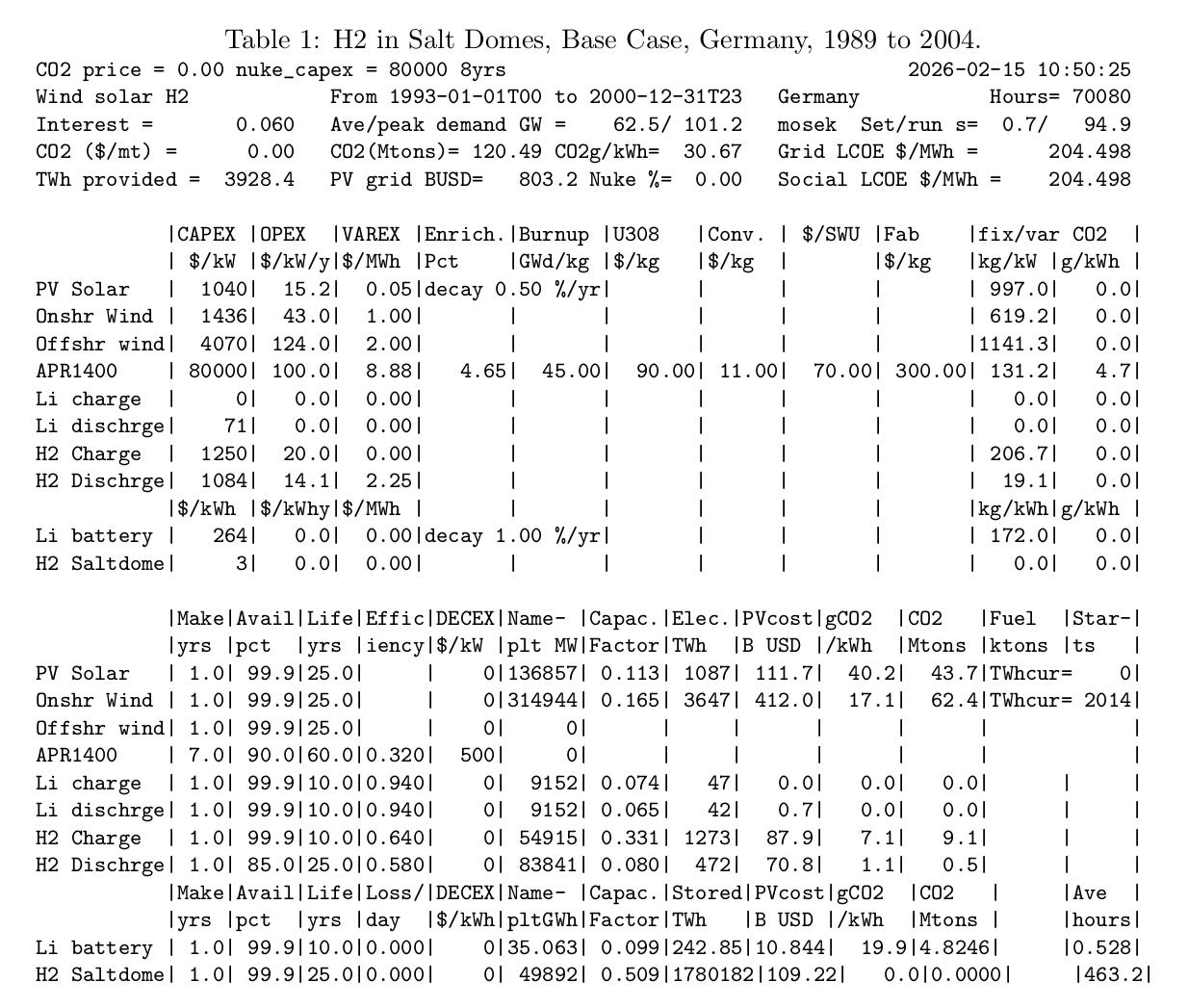
Figure 1 is a barchart of some of the most important numbers. Batteries are so expensive, the model makes almost no use of them. Instead it relies heavily on salt dome storage of hydrogen, installing just under 50,000 GWh worth of H2 storage. The H2 storage system cost is one-third of the total present valued cost of the gird. To charge this storage capacity in time to meet the demand, the program has to install an immense (probably infeasible) amount of wind and solar, 127 and 315 GW’s nameplate respectively. The total is 7 times the average load and 4.4 times the peak hourly load. This pushes the actual capacity factors down to 0.113 (solar) and 0.165 (wind). Over 2000 TWh’s of wind had to be curtailed. The result is extremely expensive electricity, 20.5 cents/kWh, with a fairly low CO2 intensity of 31 grams CO2 per kWh.
This grid was the result of running the model on Germany’s actual hourly weather from 1989 to 2004 and requiring the minimum cost grid that satisfied the demand in every hour. It turned out the critical period was the 1996/1997 winter, Figure 2.
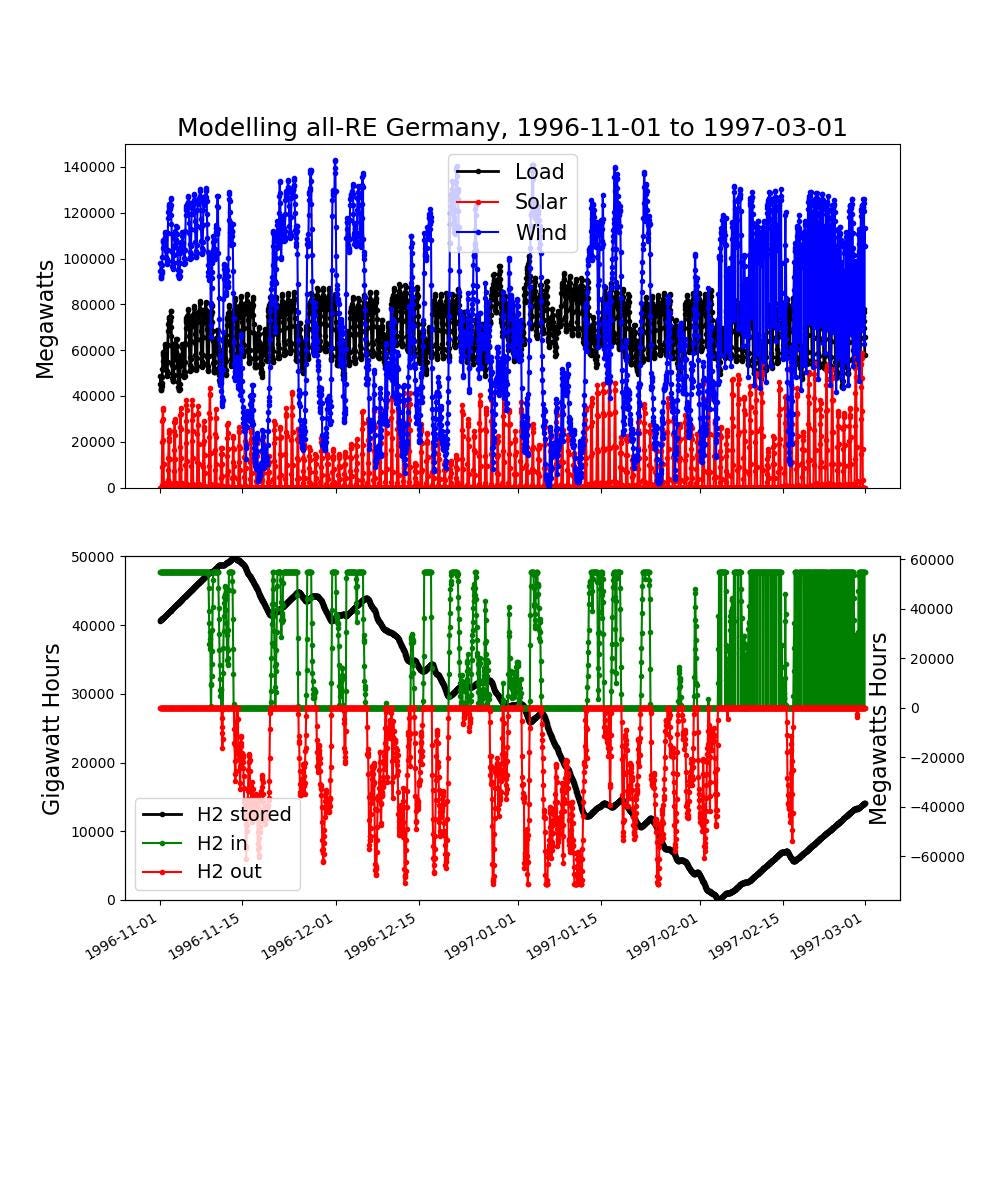
Figure 2. Late 1996/early 1997 dunkelflauten. The reason why wind/solar appear to be capped at around 150 GW despite 450 GW nameplate is any power produced above current load plus H2 charge capacity has to be thrown away.
Between November 13th and February 4th, Germany experienced a series of dunkelflauten. The GKG LP is a perfect foresight model. It saw what was coming, and charged it’s hydrogen storage right up to brim. But at 1400 on November 13th, it had to start drawing down. Despite periods in which the wind/solar power exceeded the load, this drawdown continued until February 4th. At midnight on February 4th, the H2 storage was empty. But then the wind kicked in, an the program was able to start refilling the salt dome.
The point is it wasn’t any single dunkelflaute that stretched the grid to its absolute limit, but a whole series of dark lulls, the longest of which was six days. A model that only focused on the “worst” dunkelflaute would be completely misleading.
Something somewhat similar is happening to Germany this winter. Fortunately Germany has not been able to achieve a pure renewables grid, but it is highly dependent on LNG which has some of the same characteristics as hydrogen. Figure 3 shows German gas storage over the last eight years
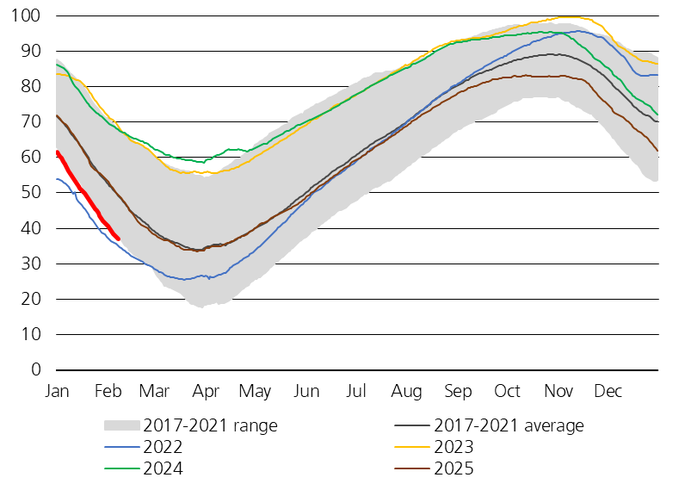
Figure 3. German gas storage 2017 to 2025
After three mild winters, Mother Nature turned nasty. German gas is now at 27% capacity, Figure 3. Salt cavern storage requires cushion gas, which is effectively unretrievable. This heel can be as much as 20% of the cavern volume. I don’t know if these numbers are net of the cushion. But Germany is awfully close to uncharted territory.
If you are going to test Mother Nature with intermittent power sources, you had better model her behavior correctly. When you do that the actual capacity factors can be well below the average capacity factors, even if you invest in a great deal of storage capacity.
Dunkelflauten is plural. Think children, brethren.
As someone who has lived in a similar climate as Germany for 32 years, and as a home solar and battery system owner, let me tell you solar sucks here. My capacity factor even on a good sunny January day struggles to reach 3%. On a heavily overcast day it is a rounding error to 0%. Even the best days in high summer are under 30%, and in this climate those days can be counted on your two hands. And the battery costs an arm and a leg and can only store 3 hours at full bore. In all it's 23000 euros worth of kit that saves maybe 1500 euros a year. The company that installed it went bankrupt so if something happens I'm screwed.
In the real world, solar and batteries just don't work in this climate. The sun goes out in fall and doesn't amount to much till the daisies. The equipment is expensive, uses large amounts of non renewable resources such as nickel, aluminium, steel, glass, lithium, etc. It doesn't displace actual fossil generators - indeed it locks us into using them indefinately under the euphemism of 'backup'. The grids here are winter-peaked, when solar is out. It's a bad idea all round.
Germany should be the abject lesson. It's industrialized, has a high population density, is not very sunny and not very windy.
It does have good salt desposits for storage. I do not understand why they don't switch to isobaric operation using brine compensating columns. Far easier on the cavern (no pressure cycling) and you can get nearly 100% cavern utilization - no blanket gas. Plus there's way too much brine generated in forming the cavern anyways, so you can put the brine to good use. And you get some pretty surface brine lakes with cool salt crystals.
Now this is all just for electricity. An elephant in the room is Germany has failed to reduce oil consumption. it is the same as it was when they started with their so called Energiewende 3 or 4 decades ago. How are intermittent solar panels going to replace petroleum?
https://ourworldindata.org/grapher/energy-consumption-by-source-and-country?country=%7EDEU
Reviewing the most recent data, from 2024 to 2025, indicates that renewables in Germany have stalled. From 57.1% in 2024 to 57.3% in 2024, an improvement of just 0.2%.
https://www.destatis.de/EN/Themes/Economic-Sectors-Enterprises/Energy/Production/Tables/gross-electricity-production.html
Are the Teutons stuck at the Betz limit?