
Unless you are cheaper than coal, don't bother

I’ve told the Mrs. Gorman story before; but it’s worth repeating. She eloquently articulated a universal concern.
A portion of mankind is awash in electricity. For these lucky humans, darkness has been banished. They live in homes and work in offices where 70F is too hot in the summer and too cold in the winter. All the hot water they can use is available with a flick of the wrist. All the ice they can consume is available on demand. Food can be stored pretty much indefinitely. Machines wash and dry their clothes and clean their dishes. Electric powered robots are taking over manual task after manual task, freeing up people to do all kinds of mischief. Electricity powered server farms store all the world’s knowledge, millions of terabytes of trivial data, and very little wisdom. Electricity is the foundation of their economies and their wealth.
For these people, it is hard to imagine what life without electricity is like. Currently mankind consumes electricity at a rate of about 3,000 gigawatts(GW). But the distribution is horribly uneven as Figure 1 shows. The USA consumes 1,500 watts per person. The Scandinavian countries considerably more. But most of Latin America is below 250 W. Most of South Asia below 125 W. Much of Africa below 25 W. The national averages mask wide disparities. Nearly a billion humans have no access to electricity at all.
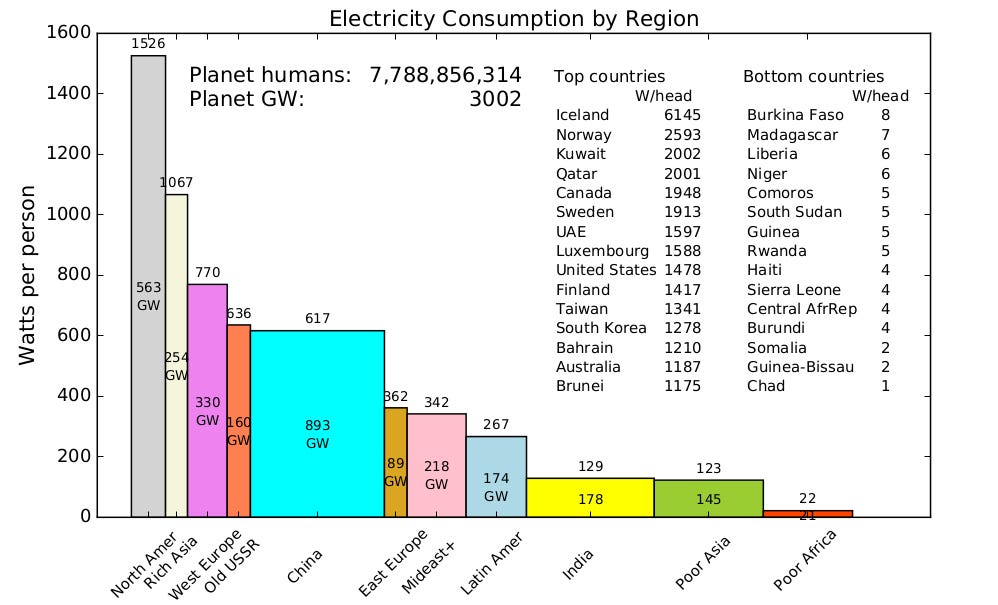
Figure 1. Per human power consumption by region. Width of each box is regional population. Area is regional power consumed.
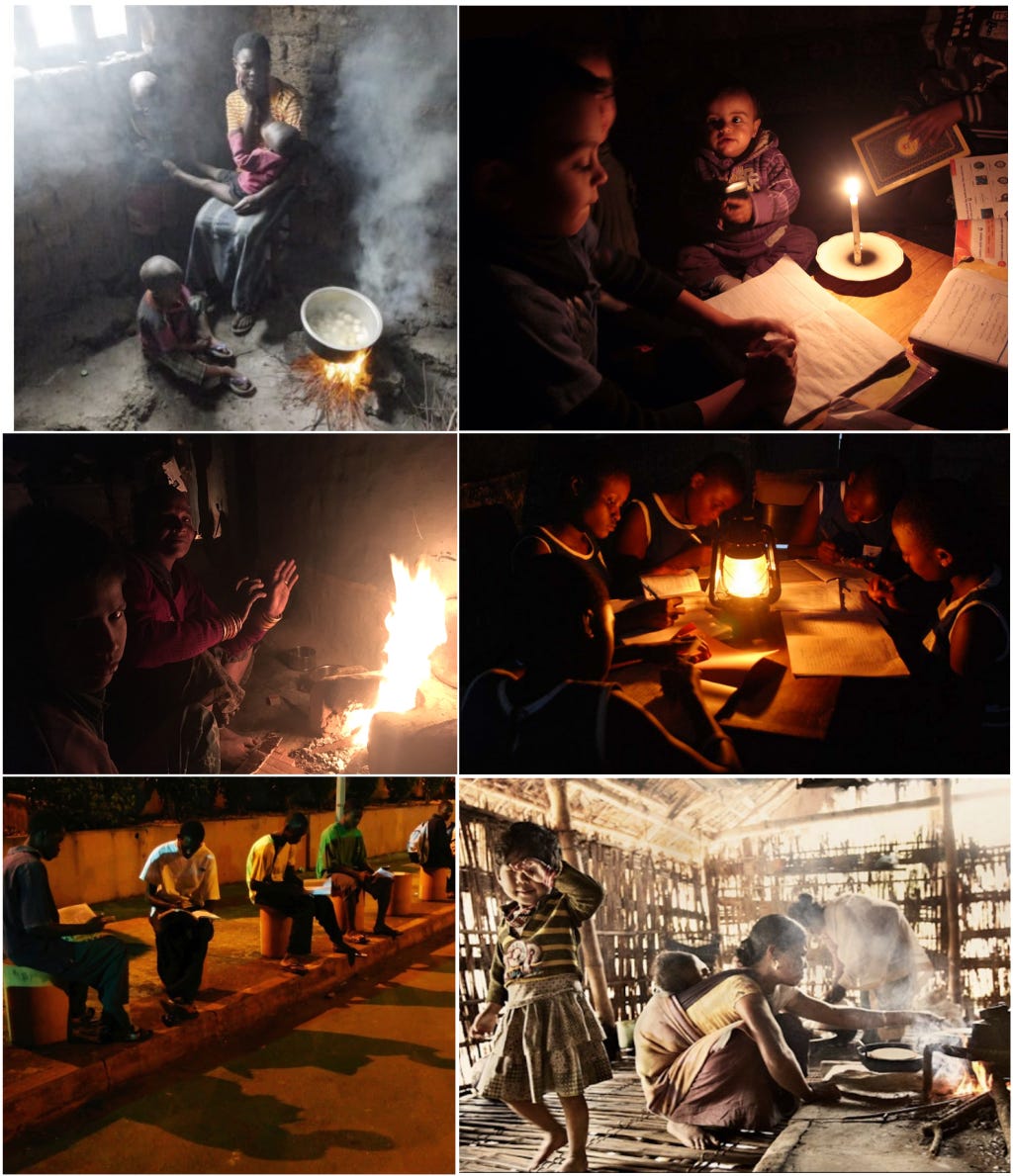
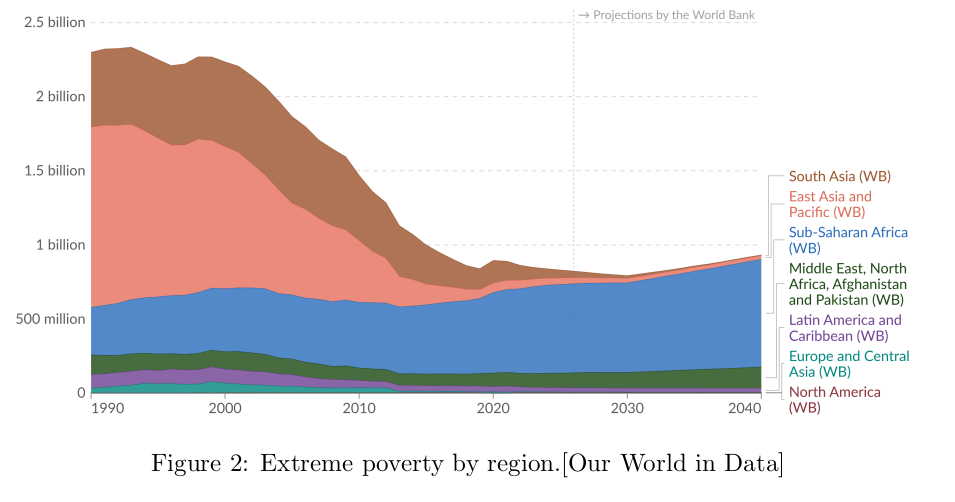
Things are not getting better. After considerable progress in the first two decades of this century, extreme poverty (income less than 3 international dollars per day) is no longer declining. It has stagnated at around one billion humans. The World Bank now expects extreme poverty to start rising. That means more women cooking over wood and dung fires in confined spaces. That means more kids won’t have the light they need to learn the skills that are essential to breaking the bonds of poverty.
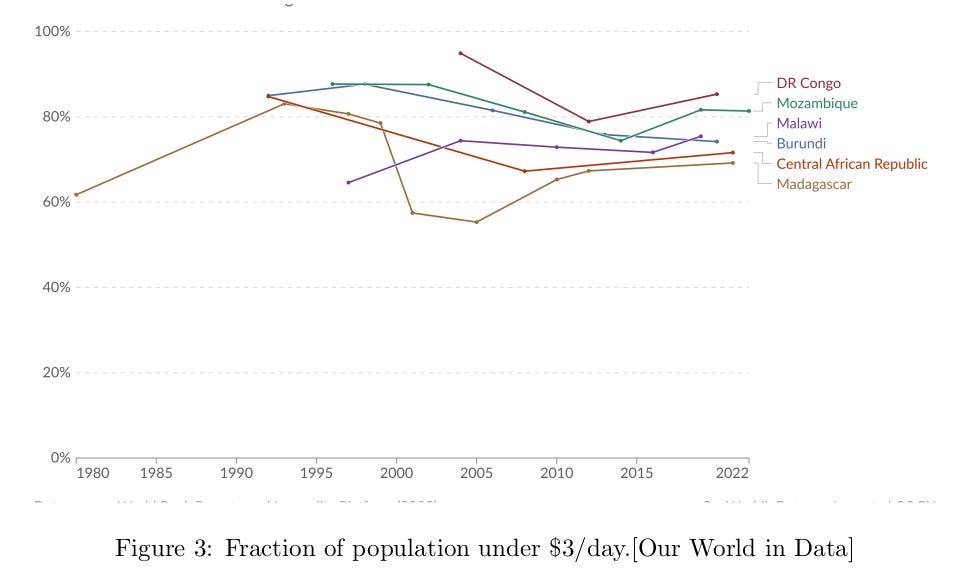
Much of this poverty is in Africa. There are at least 6 African countries where most of the people attempt to live on less than 3 $/day. The numbers are not dropping.
Bright bubbles that tell a tragic story
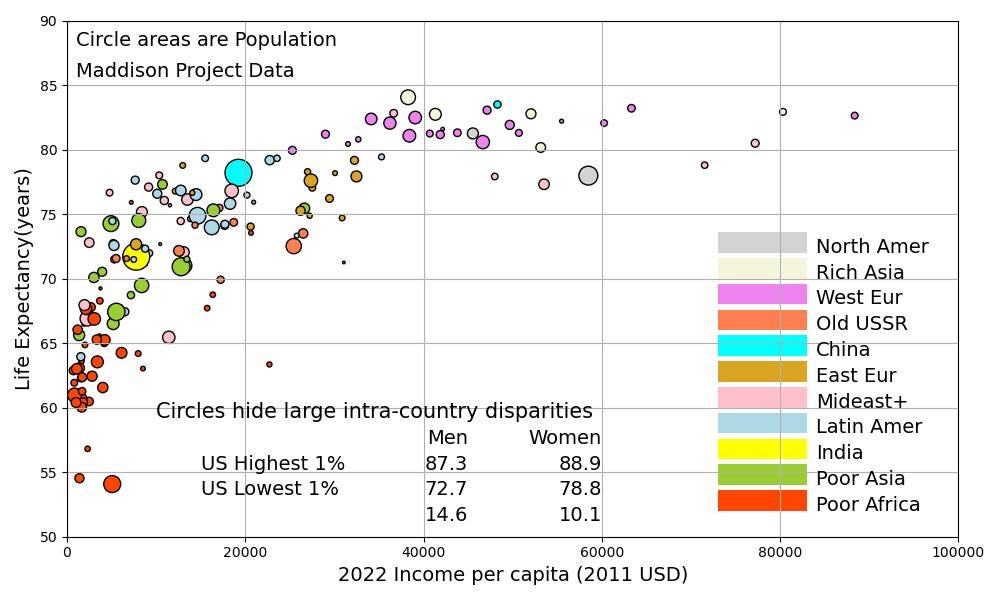
Figure 4. Life expectancy versus GDP/head. Each circle is a country. The circles hide large intra-country disparities. In the USA, a wealthy country, the difference in years of life expectancy between the top 1% in income and the lowest 1% is 14.6 (men) and 10.1 (women).
Globally the worst health hazard of all is being poor. Nothing else is close. The difference in life expectancy between the poorest and wealthiest humans is measured in decades, Figure 4. Wealth requires electricity. A rough rule of thumb for poor economies is every kWh produced is worth six dollars in GDP, Figure 5.
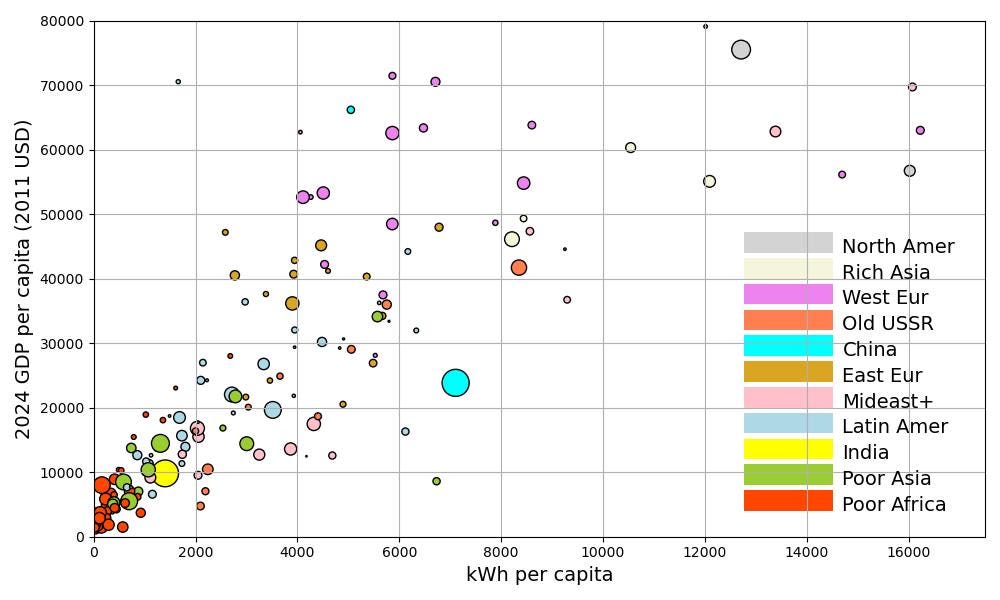
Figure 5. GDP versus 2024 electricity consumption
Another way to look at this is via the United Nation’s Human Development Index(HDI). The HDI is a somewhat arbitrary combination of longevity, wealth, and education. Figure 6 plots the HDI against electricity consumption. Unfortunately, the HDI tends to squash countries together. Looking at the HDI, you might get the impression that the quality of life in Chad is maybe half that of Norway. The table inset into Figure 1 tells a different story. The top 15 countries consume something like 500 times as much electricity per person as the bottom 15. But Figures 4 and 6 do make a couple of points:
1) For high electricity consumers, the curve is rather flat. These people could get by with a little less electricity without a major impact on their life expectancy.
2) But for the low consumers, the curve is quite steep.
For these people, a little more electricity is literally a matter of life and death. Consume less does not work for them.
3) The size of the circles represents population. An awful lot of the planet’s humans are in the steep part of the curve.
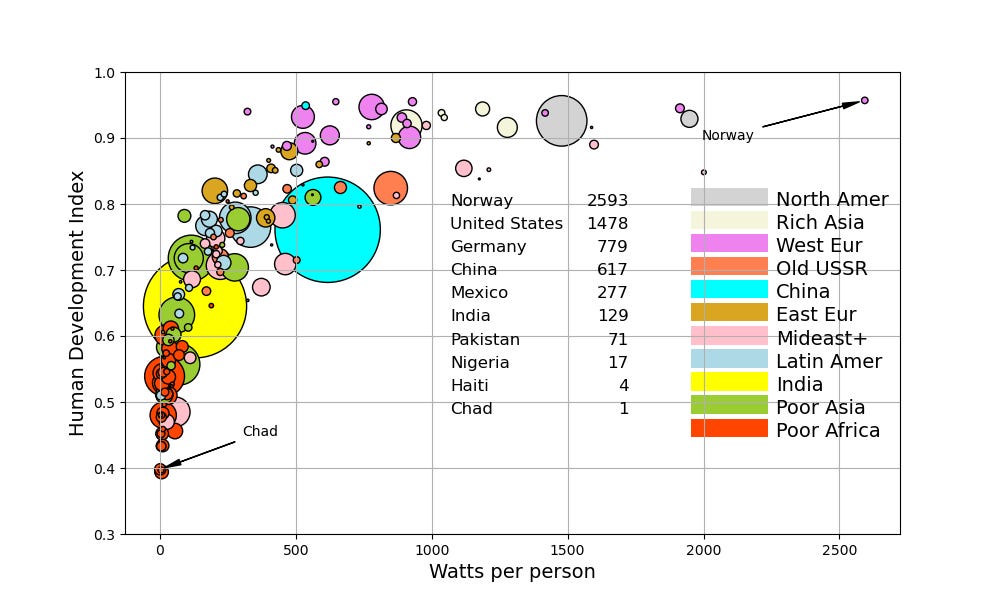
Figure 6. Human Development Index versus per capita electricity consumption.
If mankind is to prosper, then clean, dependable electricity must be available to all. And we must provide this power without polluting the air we breathe, without poisoning the land we live on, and without impacting the climate we depend on.
But here’s the important part, Figures 4, 5, and 6 tell us that electricity must be cheap. Electricity that makes people poorer is a health hazard. 15 cent/kWh (Vogtle 3/4) and 18 cent/kWh (Hinkley Point C) electricity is making people poorer. If you are not cheaper than coal (4-5 cent/kWh), you are a health hazard. Unless you are cheaper than coal, don’t bother.
Why take any radiation risk at all?
About a year after Three Mile Island, the utility, Metropolitan Edison (MetEd) needed to release some krypton-85 from the wrecked TMI2 containment, so that workers could start cleaning up the mess inside. Krypton-85 is primarily an electron emitter with a 10.7 year half-life. Electron emitters have to be ingested or inhaled to go any real damage. Krypton is a noble gas. It does not react with anything. If you breathe it in, you will breathe it out. Thus, the concentration in the lung is the same as the concentration in the atmosphere. The dose coefficient, the ratio between dose rate and krypton concentration, is a tiny 0.0000000000019 mSv/d per Bq/m3. Kr-85 is regularly released by nuclear plants. For this release, no member of the public would get a dose of 0.01 mSv. The LNT Lost Life Expectancy from 0.01 mSv acute is 3 minutes; the SNT LLE is 3.5 milliseconds.
MetEd held a townhall to explain to the locals what they were doing and why. Two of the attendees were the Gormans, who lived about 1.5 miles from the plant. Beverly Gorman and her husband had two children who at the time were teenagers. The Q&A session resulted in this exchange, between the Gormans and MetEd VP Robert Arnold.
Mr. Gorman:
I want a straight answer. How much radiation were we exposed to the first two days after the accident?
Arnold says the estimate is 83 millirems (0.83 mSv) and then attempts to compare that to background levels.1
Mrs. Gorman jumps in:
I dont want any flowery speeches. Can you tell me my children have suffered no physical damage?
Arnold:
We would have to say that your children did receive some radiation from the accident at Three Mile Island. Any radiation could result in some cell damage, whether it is from a school building, the ground where they live. The judgement has to be made if the cell damage is at levels that are acceptable. I don’t know anybody who could decide.
Mrs. Gorman:
You are proposing to expose them to more. I have to live here. We don’t have the money to move away. I don’t think they should be subject to more.
Afterwards Mrs. Gorman was still very upset. Here she is talking to a reporter.
I didn’t get a good answer. I want somebody up there to tell me my children did not suffer physically from the TMI accident. Yes or no. That’s all I want to know. All I hear is rems and millirems. I just want a straight yes or no. It’s always a a long drawn out answer. If I can’t be concerned about my children’s health, then I can let them eat jelly beans for breakfast, and stop worrying about what they eat and how long they sleep. It’s all for nothing if they are sacrificed to nuclear energy.
Here’s what I think Arnold should have said.
Mrs. Gorman, the answer is no. Not only will there be no measurable harm, your children are not being sacrificed to nuclear energy. If TMI did not exist, its dependable electricity would need to be replaced by fossil fuel. That fossil fuel plant will cause far more harm than nuclear. Not producing that electricity would cause still more harm. Nuclear is the cheapest source of electricity. Nuclear is making your kids wealthier than they otherwise would be. And wealth means health. Nuclear means your children will live longer than they otherwise would.
This argument requires that nuclear be cheaper than fossil. If this is not the case, Arnold can’t use this argument, and I do not know what to tell Mrs. Gorman.
This was a very conservative number based on a person who stayed 0.5 miles NE of the plant outdoors for the entire period. Readings in other quadrants were much smaller.
A society with electricity will always be more prosperous that one without regardless of whether electricity comes from power plants powered by burning charcoal (this is already happening under the moniker "biomass" all over Africa. Literally burning forests to produce electricity but using coal is sacrilegious our here).The romanticization of energy poverty is the most immoral things we are doing to one another on this planet.
https://thekenyatimes.com/opinions/nuclear-energy-in-kenya-siaya-plant/
Unobservable harm is indistinguishable from no harm.