
Let's be constructive for once
Replacing MACCS2 with HYSPLIT as the NRC plume model

When the nuclear power establishment is feeling unusually polite, they will call your preacher “unhelpful” or “counterproductive”. For these people expensive nuclear is plenty good enough. You bet it is. The more money they can extract from the ratepayer and the taxpayer the better. If trying to stop this ripoff and allow nuclear power to fulfill its promethean promise of a very cheap, nearly limitless, source of pollution and CO2 free electricity for all humanity is counterproductive, the Gordian Knot Group pleads guilty. But continually being critical of the current regulatory system, however misbegotten, does get repetitive and predictable. So let’s try to be constructive for once.
Here’s something that the current establishment should be willing to do. Replace NRC’s MACCS2 Gaussian plume program with NOAA’s HYSPLIT Lagrangian puff program as NRC’s official plume model.
Despite the imposing names, the basic ideas underlying each model are simple. A Gaussian plume model assumes a continuous source which spreads downwind and outward at a constant wind speed and direction. The wind speed and all the other weather variables are fixed during the run. MACCS2 can segment the plume. The plume consists of segments of time; but, for each segment, the wind and other parameters are fixed. This is not how weather works.
After wind speed and direction, the most important weather variable for dose rate purposes is the rainfall pattern. Rain quickly washes out the radioactive particles and can make orders of magnitude differences in the groundshine. A Gaussian plume model has no hope of modelling a real world rain pattern.
A Lagrangian puff model assumes the release is a series of puffs, and then tracks each puff separately. The wind and all the other weather numbers, eg stability, precipitation, can be different at different locations and times. The input is a weather pattern through time, usually on a grid. When a puff enters a particular grid area at a particular time, it moves and spreads (and rains) according to the weather at that time and location.1 In HYSPLIT when a puff spreads to the point that it covers more than one grid area, the puff is split into two or more new puffs. (That’s where the “split” in the name comes from.) All the puffs are summed together to get the deposited and ground level radionuclide levels at each location through time, from which we can compute the dose rate profile for that location.
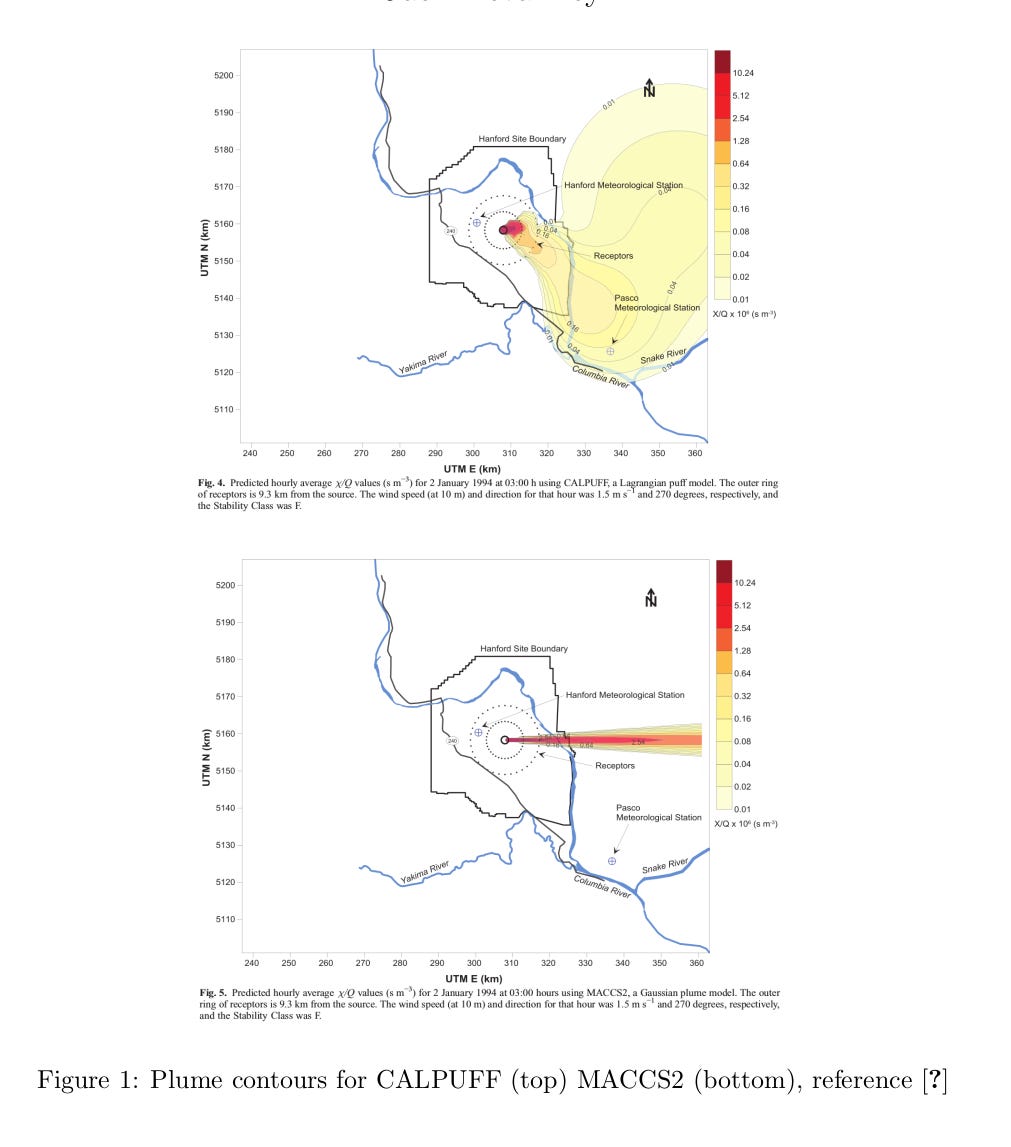
Not surprisingly, the Gaussian and puff contamination patterns can be completely different. Figure 1 shows how different the results can be. These figures track a hypothetical release from the Hanford processing plant, which started at 1994-01-02 at 0300, when the wind was westerly. The puff model used in this exercise was CALPUFF which is the EPA standard atmospheric pollution model. In the CALPUFF run, the wind changes on a hourly basis spreading the plume around. The MACCS2 run is forced to stick to the initial wind speed and direction resulting in an entirely different, far more concentrated plume.
Preposterously, for LNT this difference need not be important. LNT claims dilution buys you nothing. One person receiving 50 mSv produces the same cancer incidence as 50 people receiving 1 mSv. If the population distribution is uniform, the LNT harm will be the same in both the top and bottom of Figure 1. To first order, the LNT harm depends only on the size of the release, not how it is spread around.
The NRC mandates that license applicants use MACCS2 in the Probabilistic Risk Analysis(PRA) process which involves both LNT and averaging the weather over a year. In 2004, the NRC commissioned a comparison of MACCS2 and puff models for this process.\cite{molenkamp-2004}. They predictably found that the LNT based PRA numbers weren’t that different. They concluded there was no need to change the PRA methodology.
But that does not mean that MACCS2 can give us a remotely correct prediction of the dose rate profiles in an actual release. If they make the change, the NRC will have a model that can actually be used in a release to predict the exposure, given what ever the weather forecast is.2 Finally if we ever change to a realistic harm model in which dose rate matters, we will be in a position to actually use that model correctly.
Who can be against the change? Follow the science.
Critically, HYSPLIT models the interaction between aerosols and clouds which is a key factor in determining how much of the radioactive material ends up in the rain.
Sandia has merged HYSPLIT and MACCS2, basically pasting the dubious MACCS2 PRA post-processing of the plume onto HYSPLIT.\cite{sandia-2022} So I think that job has already been done.
Good idea Jack. The current environment is more amenable to changes like you propose.