
Chernobyl: the perfect experiment
When are we going to stop killing people by making nuclear expensive?

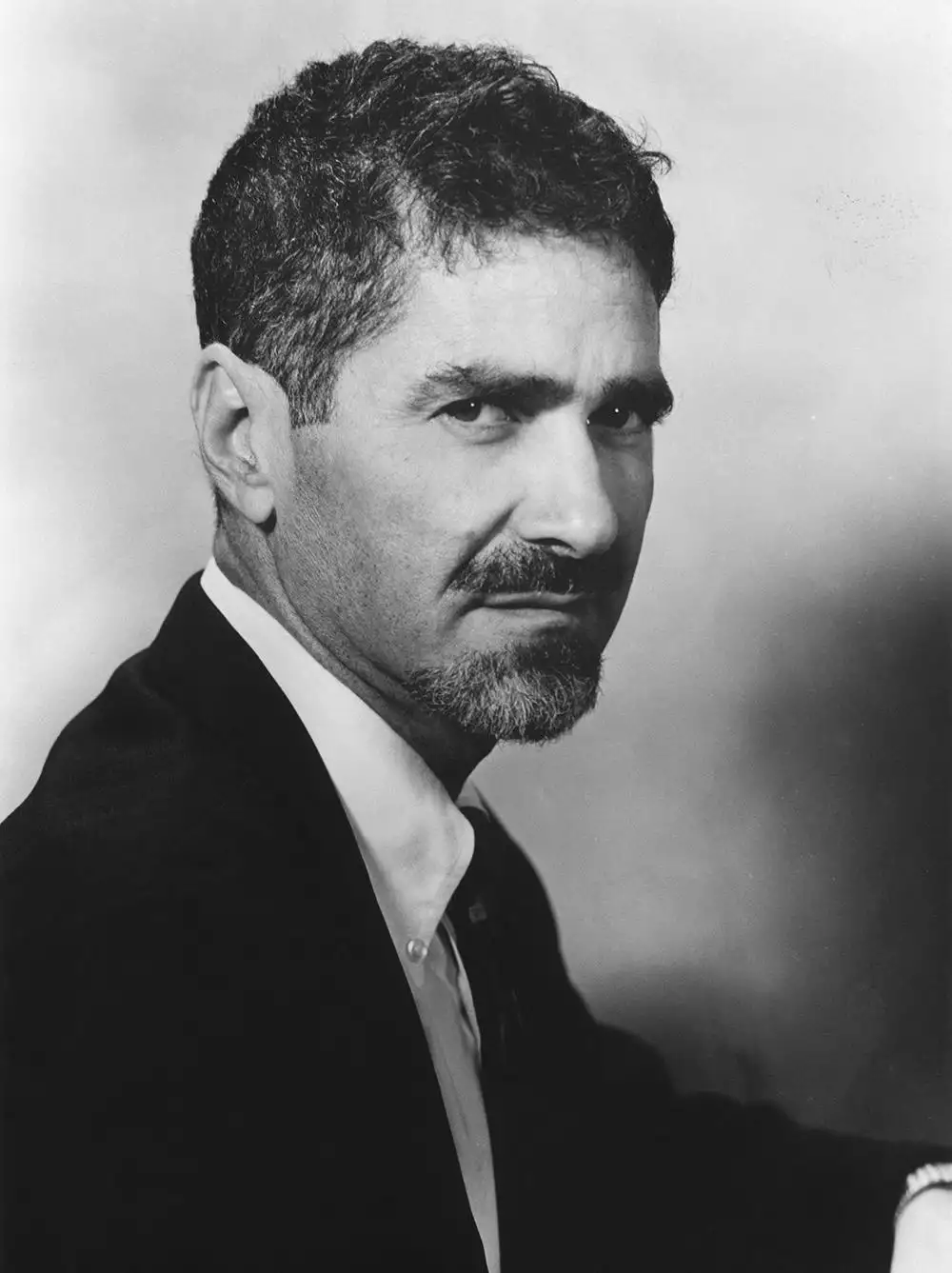
If you don’t pursue safety in a way that is cost effective, you are killing people.[David Okrent, Past chairman, Advisory Committee on Reactor Safeguards]
Suppose early in 1979, you asked yourself what is the most definitive experiment we could do to learn about the radioactive harm associated with a nuclear power plant release. The obvious answer: a big release would be that experiment. But you would immediately reject that idea on both ethical and economic grounds. Since then we’ve inadvertently run that experiment three times. Let’s look at the results.
Three Mile Island
At TMI, the average additional cumulative dose was about 0.015 mSv, a bit less than a one-way flight between New York and Los Angeles, but spread over a much longer period. The TMI study group did find one member of the public whom they thought received a dose of 0.37 mSv over several days. That’s about the background dose rate of the high end group in the Karunagappally study.\cite{nair-2009} These people suffered that dose rate for most of their lives. They had a slightly lower cancer rate than their low dose rate neighbors. TMI was a non-event in terms of radioactive harm.
TMI is the typical nuclear power plant release. We can expect most future NPP releases to be similar; but, despite the fact that TMI was an multi-billion dollar meltdown, it was far from the worst possible release.
Fukushima
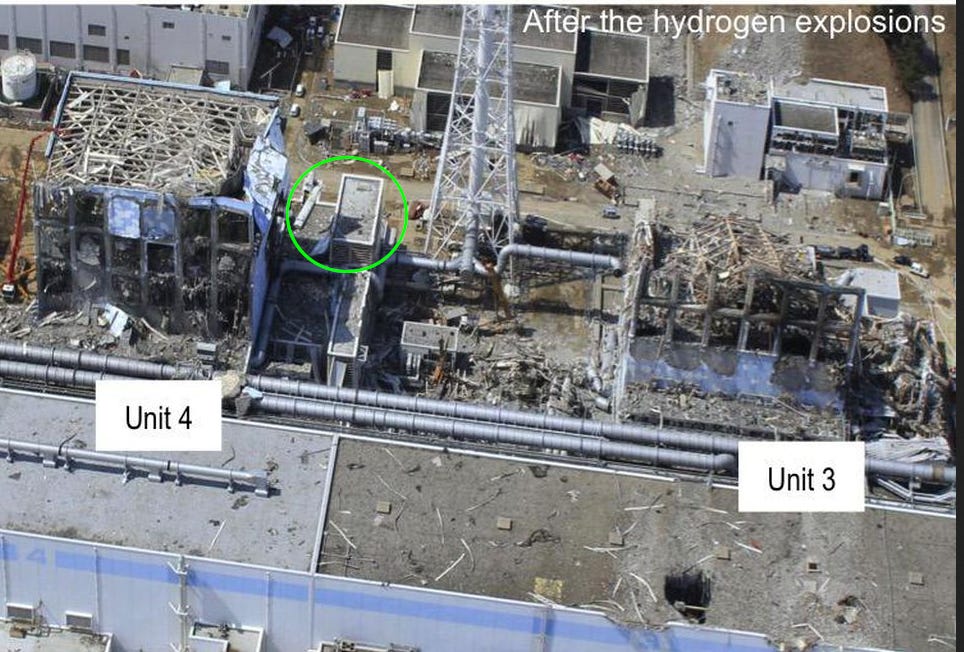
Figure 1. Fukushima. Control room circled was manned throughout the release.
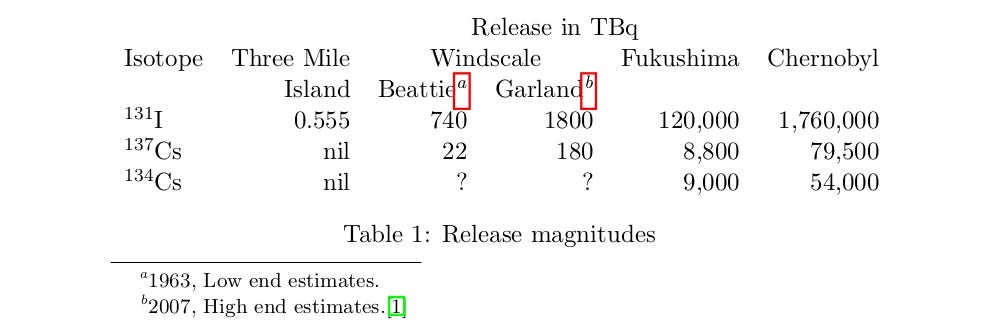
Fukushima was a far larger release than TMI, at least 100,000 times larger, Table 1.
At Fukushima, few if any members of the public would have received 2 mSv or more in a day had there been no evacuation. We have never reliably detected an increase in cancer at dose rates much less than 20 mSv/d, even when those dose rates were incurred for decades. If there is any effect at all on the public from radiation, it will be undetectable. In fact, in 2021, 11 years after the release, UNSCEAR was unable to detect any such harm.\cite{unscear-2021}[p 106] A risk you cannot detect is hardly a risk at all.
So far we have not even been able to detect an increase in cancer in the Fukushima personnel that stayed on the site throughout the release, some of whom suffered far worse dose rate profiles, than any member of the public.\cite{kitamura-2022} Some of these guys served several eight hour shifts in control rooms that were a few meters from the breached reactors, Figure 1.
A Fukushima sized release should be relatively rare among future nuclear plant releases, but it is still not a worst case release.
Chernobyl
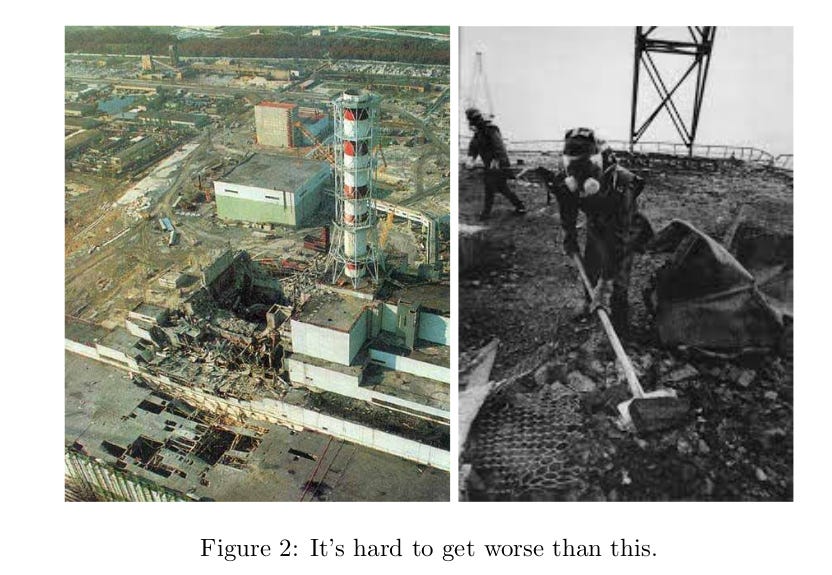
The Chernobyl release was 9 to 140 times larger than Fukushima, depending on which isotope you focus on. The Chernobyl explosion was pretty close to a worst possible release, the perfect experiment
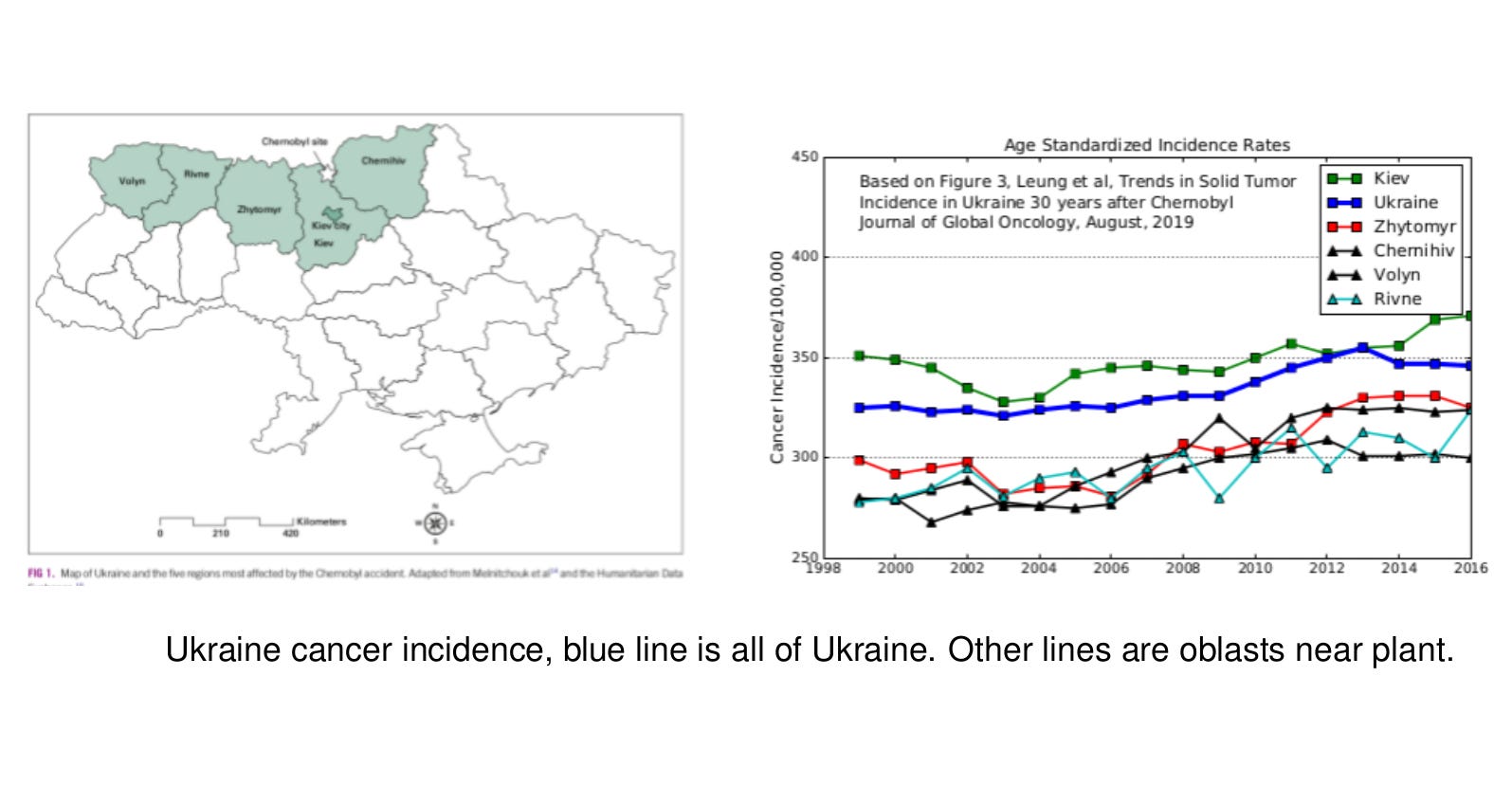
Figure 3. Cancer incidence in Ukraine
But to avoid dose rates higher than 2 mSv/d only about 50,000 people would have had to evacuate, and then only for 40 days. In 2019, a team from Harvard Medical School queried the Ukrainian National Cancer Registry.\cite{leung-2019} They could find no systematic differences in the solid cancer incidence rates in the districts close to Chernobyl compared to the country as a whole, Figure 3. 33 years on, the 1000’s of cancers predicted at Chernobyl, simply never happened. During the release, the plumes were mostly east-west and to the northeast. See left frame in Figure 4. Those oblasts had lower cancer rates than the national average, probably because they are highly rural.
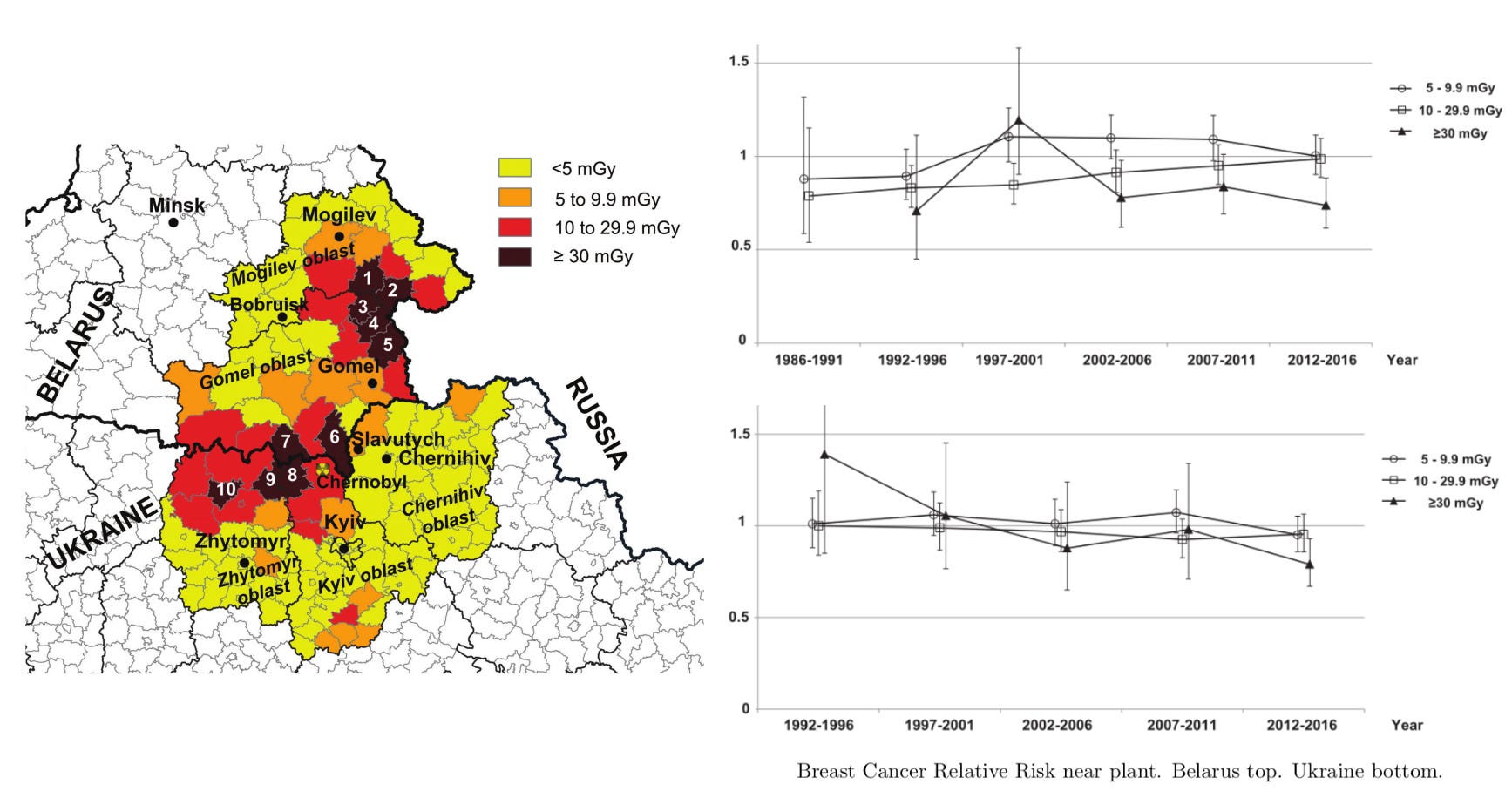
Figure 4. Breast Cancer near Chernobyl
Breast cancer is one of the more radiosensitive diseases. Zupunski et al studied breast cancer incidence in the rayons (roughly counties) close to the plant.\cite{zupunski-2021} There was no statistically significant difference in the breast cancer rate between the high dose rayons and the low, Figure 4.. If anything, the higher dose rayons tracked below the lower. Not only have the thousands of deaths failed to materialize; but we have been unable to find even a hint of an increase in non-thyroid cancer in the general public from the Chernobyl release.
However, some children in the area received extremely high thyroid dose rates due to drinking radioiodine contaminated milk. Iodine concentrates in the tiny (10 gram) thyroid gland, multiplying dose rates to this organ by more than 1000. We may eventually see 100 to 200 premature deaths from thyroid cancer in this group. All these tragic cancers could easily have been prevented by temporarily banning local milk consumption. I-131, the isotope that causes this problem, effectively disappears in about 10 weeks. Properly handled, there would have been no detectable harm to the public from radiation at Chernobyl.
A Lesson Not Learned
So we did the definitive experiment. The result: even in a very large power plant release, dose rates to the public are almost never higher than the dose rates our bodies know how to handle. Nature had to equip us with those repair systems to cope with the onslaught of DNA damage from our internal metabolic processes, which damage our DNA at a rate that is at least 25,000 times higher than the damage rate from average background radiation.
Nuclear power plant casualties are extremely expensive economically, which means it’s in the operators’ interest to build robust plants and operate them prudently. But from a public, radiation point of view almost all releases will produce no detectable harm, and the very worst releases are no worse than a bad refinery fire at killing the public.
This puts nuclear in the same category as wind and solar, when it comes to directly killing people per TWh of electricity, and orders of magnitude less directly deadly than coal plants. But it’s the indirect deaths that really count. The easiest way to kill a lot of people is to make them poorer. With a few exceptions, wind and solar will do that. Nuclear will too unless it is as cheap as coal. Nuclear has been cheaper than coal, and can be cheaper again; but only if we regulate nuclear in a way that eliminates barriers to entry and forces the vendors to compete on an even playing field. Right now we are doing exactly the opposite. We are killing people.
Good and important writing, thank You! There are good reasons why famous, and quite good Chernobyl series was dealing with the "costs of lies", not "costs of radiation". Properly handled the accident would have much smaller effects- shelter in place, avoid certain fresh foods(especially for kids), and all that just for some time. Cover ups, secrecy and lies complicated the picture more than Iodine, Cesium and Strontium.
You are leaving out the true cost to the public of hampering the replacement of fossil fuels with nuclear. Death! If Chernobyl had been a coal-fired power plant of the same magnitude and duration, it would have killed at least 100,000 people on purpose, no accident. The highest insane estimate for Chernobyl's nuclear power accident and subsequent radiation, was 19,000 people killed. Your estimate is closer. So we can say that that the Chernobyl plant operation and accident still saved 80,000 lives that would have been lost to air pollution from coal.
You have a one out of a thousand chance of of dying of fossil fuel air pollution this year and so does everybody else. Are you fighting hard enough to shut down fossil fuel air pollution? We can stop 1/3 of cancer and 1/3 of lung disease and a good fraction of tuberculosis and heart disease, and save money doing it. We need to transition to nuclear as quick as we can.