
The Biological Argument against LNT
The Intrinsic Fragility of DNA [Title of Lindahl's Nobel Lecture 2015]

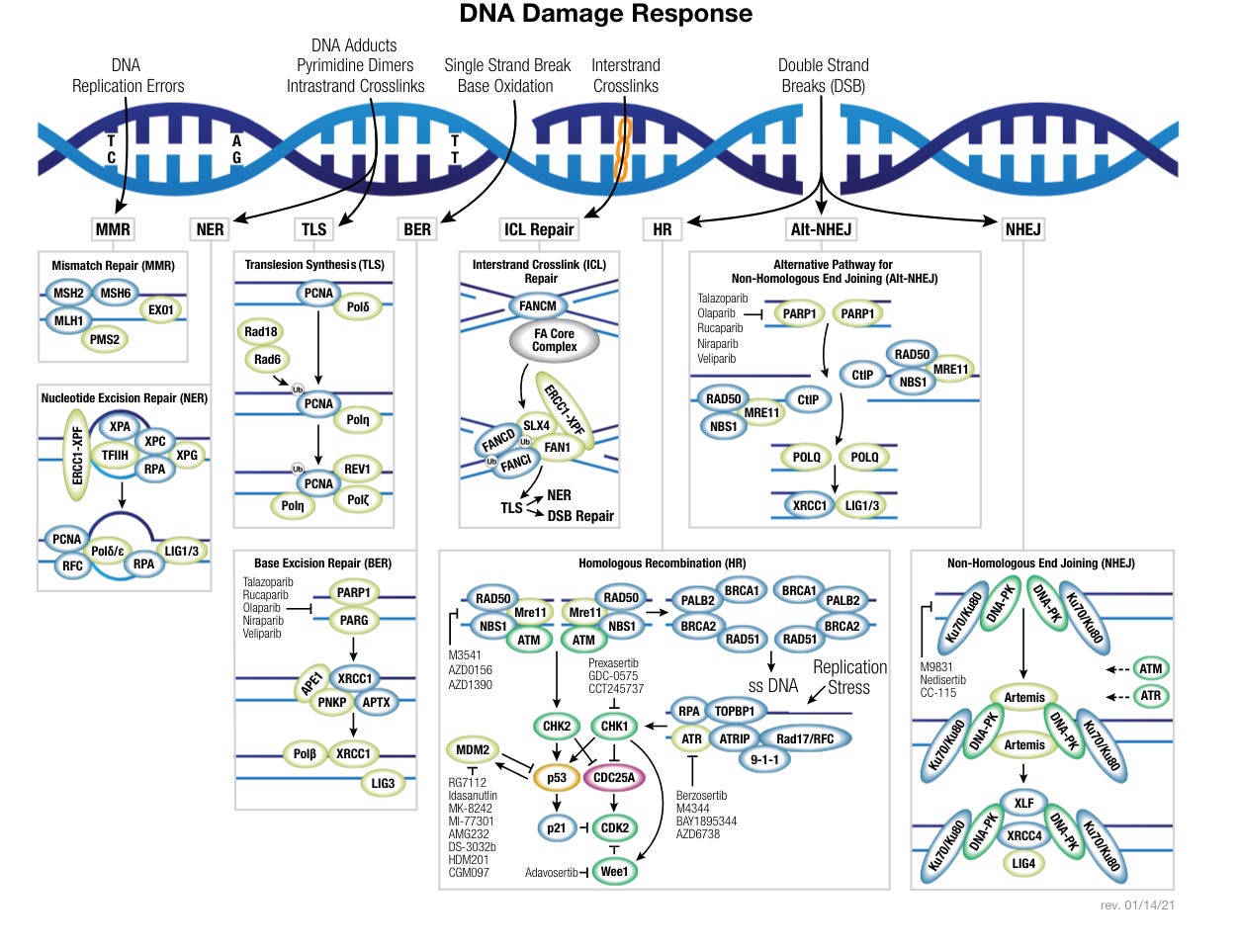
Figure 1. Super Simplified Diagram of DNA Repair Mechanisms
Debates about LNT quickly descend into he-said-she-said exchanges. Opponents of LNT point to experimental or epidemiological exposure data that appears to be non-linear. Proponents of LNT point to data that looks linear or at least is linear “enough”.
Almost all real world radiation exposure data is extremely noisy. If you focus on near-background dose rate exposures as both sides normally do, the signal to noise ratio is so small that it is impossible to falsify any semi-reasonable radiation harm model. Such data is easy to manipulate to suit the model of choice. One way of doing this is to choose the “right” control group. To make matters still worse, both sides almost always fasten on total dose. Any opponent of LNT who focuses only on total dose has already conceded the debate. LNT is the only theory in which the only thing that counts is total dose. At the end of the day, the results are inconclusive; and Emperor LNT continues to reign.
We must focus on the biology. The first question I ask an LNTer is: do you believe our bodies are able to repair DNA damage? If he says “Yes”, he has denied LNT. If he says “No”, tell him to Google “DNA repair”. He will get 139 million hits. Go ahead, try it. Or better yet, check out Berry and Uno’s
DNA repair animations. They are mesmerizing, even if like me you have almost no idea of what is going on. The evidence for DNA repair is indisputable. Do not let the LNTer out of that corner. He can either deny LNT or deny the biology.
LNT’s foundational premise is radiation damage to our DNA is unrepairable. This assumption implies both that damage is equivalent to harm and it is additive. Additivity implies linearity. The no repair doctrine dates back at least to the 1920’s, when it was conventional wisdom that changes to genes were not correctable. This was defensible at the time. Nobody really knew what a gene was other than a construct that explained some experimental data.1
DNA was not discovered until 1953. At first, it was assumed to be a very stable molecule. How else to preserve the existentially important information it contained? Soon there was mounting evidence that this was not the case. But it was not until the 1970’s that scientists, led by Tomas Lindahl, realized just how fragile DNA was and how our bodies dealt with the massive damage inflicted on our DNA by our own oxygen based metabolism.2
The 1930’s geneticists were right. The information in our genes, which turned out to be short stretches of DNA encoding a particular trait, had to be preserved. But they had no conception that the double helix we call DNA is suffering 20,000 Single Strand Breaks and 10 to 50 Double Strand Breaks per cell per day. Almost all of this assault is from our own oxygen based metabolism. They would have been aghast at the fragility of our DNA.
Lindahl’s work was quickly confirmed, Lindahl and his colleagues immediately recognized that the only solution had to be a repair system that was capable of coping with this chemical carnage. They began to work out the myriad ways that the cell handles specific kinds of DNA damage. It’s a head spinning array of mechanisms. Base Excision Repair (BER), Nucleotide Excision Repair (NER), Mismatch Repair (MMR), Homologous Recombination (HR), Non-Homologous End Joining (NHEJ) and on and on, Figure 1. This work is still going on, in part because it could lead to methods for curing all sorts of maladies including cancer.
But by the time Lindahl and his colleagues had demolished LNT’s no repair hypothesis, LNT was the moat that protected the nuclear power complex castle. If it were filled in, competitive forces could overrun the other barriers. The careers and fortunes of just about all the inhabitants would be in ruins. LNT had to be defended regardless of the science.
The defenders had two main tactics:
Focus on noisy exposure data.
Ignore the biology. Fallaciously make LNT the null hypothesis which must be disproved. Focus on the noisy data, the noisier the better. If the biology is ignored and the data is noisy enough, LNT can’t be disproven.
The anti-LNTers have fallen for this. They have ignored the biology, and they have not focused on the few exposures where the dose rate profiles are large enough and different enough that LNT can convincingly be falsified. All it takes is one solid counter-example to invalidate any hypothesis. We have a number of such “ugly facts”, but none more compelling than the radium dial painters. Even the EPA acknowledges this.
EPA policy is to assess cancer risks from ionizing radiation as a linear response. Therefore, use of the dial-painter data requires deriving a linear risk coefficient from significantly non-linear exposure data or abandoning EPA policy. \cite{epa-1991}
Since the dial painter data invalidates LNT, it must be dismissed. Preposterously anti-LNTers have allowed them to get away with this.
The Muller Trap
Deflection and dismissal by itself would not have worked. Fortunately for the LNTers, they had a more powerful tactic. To replace LNT, we must have a replacement radiation harm model, that is a model that can convert any dose rate profile into a prediction of cancer incidence as LNT can. The ploy is to induce the anti-LNTers to defend an alternative model that they can shoot down. I call this the Muller Threshold Trap.
The first step in this sting is to studiously avoid calling LNT what it is, the “no repair” model. That would bring indisputable biology into the discussion. We can’t have that. Instead we want everybody, especially the opponents, to call LNT the “no safe dose” model.
On the surface, this is logical nonsense. Radiation harm models don’t say what’s safe and what’s not safe. Given a dose rate profile, they simply generate a number, a prediction of cancer incidence. But by fallaciously making LNT the defender of “the no safe dose” doctrine, they entice the opposition model to be the defender of “there is a safe dose”. Instead of a discussion of the accuracy of a model’s predictions of cancer incidence, we have turned the discussion into what is a safe dose. Genius.
Safe is a feeling. Safe is an emotionally loaded word, beloved by politicians, advertisers, and other misleaders. Every bit of ionizing radiation can create some DNA damage. Is that safe? Why not a model that says “No, it is not.”.
If the anti-LNTer is an easy mark, he will fall into the trap and respond by trying to concoct a model that claims there is a safe dose. Since nobody can define what’s safe absent of context and a subjective judgement about the risk in that situation, this is an impossibility, unless that dose produces zero risk, a threshold dose. That threshold is almost never well defined. Is it a dose rate? Is it a total dose? If so, over what period.? And what are your threshold number(s)? What dose rate profiles produce zero risk? The proposals practically never pass the “computer code” test, which is: show me the code that converts any dose rate profile into a prediction of cancer incidence according to your model. If a model cannot pass that test, it is by definition not a replacement for LNT.
The con has worked. The LNTer has triumphed. He has deflected the conversation completely away from the biology, and LNT’s denial of that biology. He has forced his opponent to defend a hypothesis that in the strictest sense is probably false, and certainly unprovable. And the opponent has not even offered a well defined replacement for LNT.
To rid ourselves of LNT,
1) We must focus strongly on the biology. The first question should always be: are our bodies able to repair DNA damage? Repeat it until you get an answer.
2) We must invoke Huxley’s “one ugly fact” principle, and point to the exposures that clearly invalidate LNT. Given our amazing DNA repair system, this requires looking at exposures involving very large doses, both acute and chronic. LNT fails miserably when confronted with such data.
3) We must avoid conflating subjective judgments about what’s safe with comparing the accuracy of a proposed model’s cancer predictions. Models don’t do safe. LNT is never, ever the “no safe dose” model. LNT is the “no repair” model.
4) We must come up with a well defined replacement model, that recognizes our ability to repair DNA damage and passes the computer code test. SNT is a simple, easily implementable radiation harm model that qualifies.
They did realize, after a long debate, that the genes were somehow connected to the cell’s chromosomes, long X-like structures, they could see with the microscopes of the time, during parts of the cell cycle.
Lindahl was a bit of a character. His Nobel acceptance speech closed with Hamlet’s conversation with the grave digger about how long it takes a body to rot. Lindahl applauds Hamlet for asking an expert “a series of logical and penetrating questions”. Calls Hamlet “an excellent scientist”.
Jack:
I confess to having been one of the anti-LNTers that fell into the trap of relabeling the LNT model as the "no safe dose" model. I think I did it as a reaction to the way that the LNT enabled nuclear energy opponents to loudly and repeatedly claim that there is "no safe dose" of radiation. A search of Atomic Insights shows that I started down this dead end path more than 15 years ago.
Your "no repair" label is much better and should be far more effective in the important effort to convince [remind] the public that our bodies evolved to overcome damage done by a hostile environment. The very same mechanisms that repair DNA damage done by using oxygen in metabolic processes works to repair damage from low level radiation. The repair isn't instantaneous, so dose rate matters far more than total dose.
I get it. Thank you.
Jack: I think that this discussion is incomplete and should add the insights from your "Eben Byers and radiothor". You said that "Strong evidence that our bodies can handle dose rates up to at least 20mSv/day." I can identify others that support this observation. One doesn't need to know the precise dose rate that is the upper range of what is safe. Just put in near zero radiological health effects below 20 mSv/day and it would show that virtually all low dose health effects models that indicate non-zero health effects in this range are wrong. Herschel