
Part 57: The NuScale Reg?

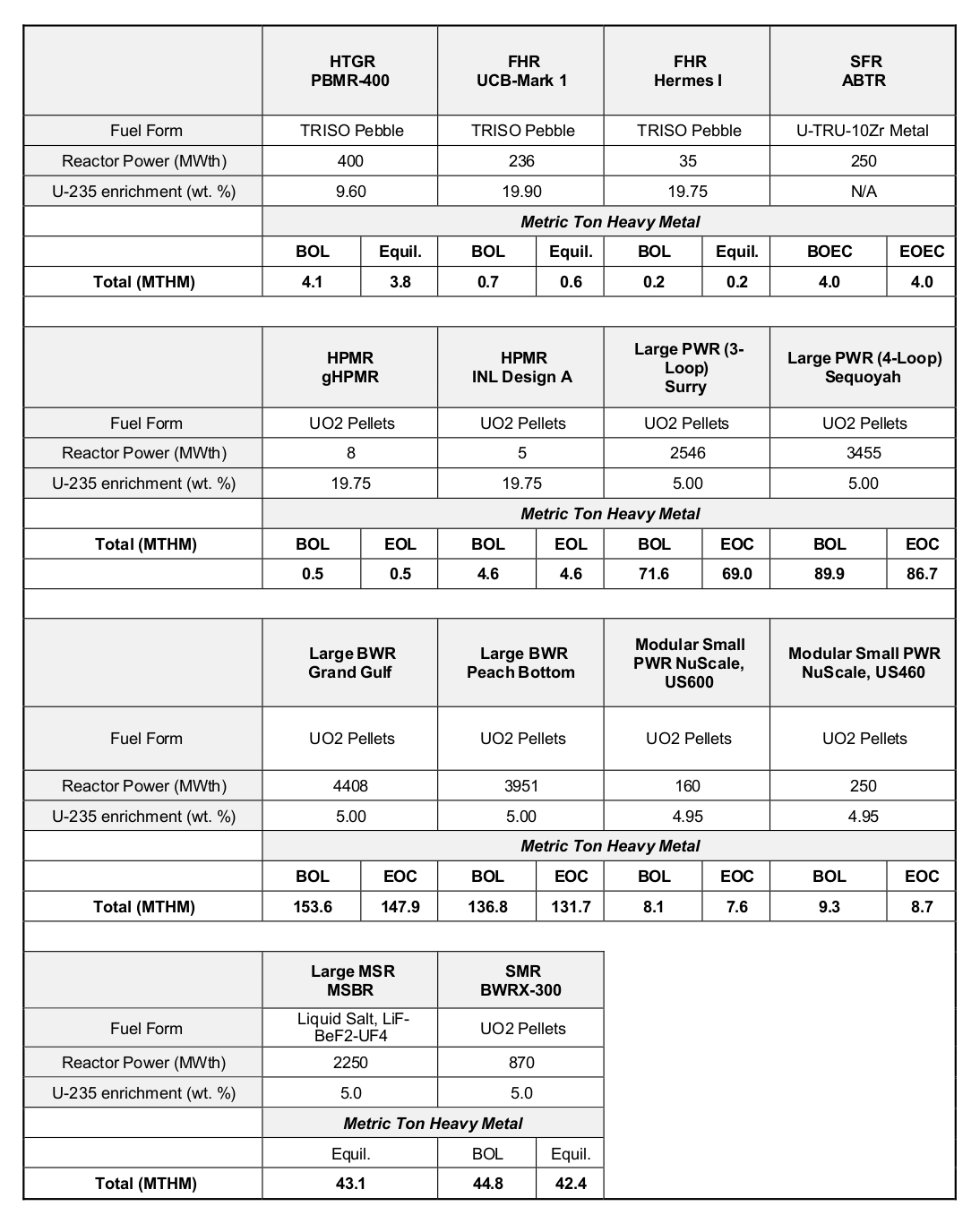
Table 1. NRC estimate of reactor “fuel weight”
The NRC has released proposed 10 CFR Part 57, Licensing Requirements for Microreactors and Other Reactors with Comparable Risk Profiles for comments. I have read through all 496 mind numbing pages. I expect to be amply rewarded when the collection plate comes around.
Let’s start with what I like about this proposal. If and only if you qualify under Part 57:
The expensive CAT teams disappear.(57.12)
Attacks “by an enemy of the United States, whether a foreign government or person” are not a plant’s responsibility.(57.12) Subpart J does requires protection from “radiological sabotage”. This seems to mean enough cameras, etc so that the plant can quickly alert local law enforcement to a threat, but the wording leave a lot of room for interpretation, and as always the NRC is the sole interpreter.
Remote operation is not automatically outlawed.(57.60)
In theory, you can have an on site staff of zero, if you can get it approved.
Nor is load following.
A plant can be “operator independent”.(57.391)
This means the NRC has determined that no operator operations are required to keep the plant from inflicting 10 mSv outside the site boundary. Such plants can be run by a GLRO (Generally Licensed Reactor Operator). “General licence” is NRC jargon for automatic license. For example, thanks to NRC’s largess, we all have a general license to have a few grams of uranium. In this case, it is any employee of an operator independent plant that has been through the plant’s training program, not an NRC approved and administered program.
N-stamp not a requirement
There is a pathway, Subpart F, for getting around the N-stamp. A plant can use a “commercial grade” component if it is “dedicated”. This seems to mean officially approved by the buyer. This approval imposes a defect reporting requirement on the buyer, which on paper is not unreasonable, but could turn into a mountain of paperwork.
No Emergency Planning Zone
The EPZ is replaced by a nebulous “site boundary”. I did not find a clear description of what the site boundary is. It seems to be whatever the plant has fenced off.
Environmental Impact Statement can be waived
The NRC might not require an EIS if no surface water or groundwater is used in cooling, and the site is “a previously disturbed area”. This may contravene NEPA, and I don’t like requiring dry cooling towers.
No resident NRC inspectors.
Save a little money.
No requirement for a simulator at each plant.
Save a chunk of money.
All this means that qualifying under Part 57 gives the qualifiers a big advantage over non-qualifiers. It does not mean that the qualifiers will produce cheap electricity.
So how do you qualify? What does Microreactors and Other Reactors with Comparable Risk Profiles mean. This ponderous phrase is repeated 87 times in the document. Comparable is a chameleon word. It can means something like “similar”. Or it can mean “capable of comparison”. A 1 GW plant can put out 1000 times as much power as a 1 MW microreactor. A 1 GW plant is comparable to a microreactor. I just did it. Even though Part 57 has many pages of definitions, comparable is not defined. I suspect that was not an oversight.
It turns out there are two requirements to be comparable. Here is Section 57.25 in its entirety.
To be eligible for a construction permit and operating license or a manufacturing license under this part, an applicant must demonstrate that its nuclear reactor or nuclear plant design and operation meets the following entry criteria:
(a) An evaluation of the applicable radiological consequences shows with reasonable assurance that any individual located in the unrestricted area following the onset of a postulated accident that bounds a broad range of design basis accidents would not exceed 1 rem (0.01 Sv) TEDE for the duration of the accident; and
(b) The total inventory of thorium, uranium, and plutonium contained in the nuclear reactor or any individual nuclear reactor that is part of the nuclear plant must not exceed 10 metric tons.
First I need to point out that basing (a) on total dose rather than the dose rate profile proves that the NRC is still using LNT despite all the blather about getting rid of this bit of biological nonsense.1 Part 57 reaffirms LNT which implies a big release is intolerable.
(a) is an exercise in probability manipulation. There are any number of PRA hired guns which will help you make the number, in part by playing with the site boundary. Their job will be made easier by the fact that the wording makes it pretty clear that the (a) criterion is based on a single isolated reactor. (Does any one really believe that you can have a major problem with one Nuscale module with zero probability of it not spreading to any of the others in a 12-pack? Check out the big pool in The NuScale Scam.) (a) will be no problem for any well connected applicant.
The real hurdle is (b). Inventory of heavy metal is a very, very strange metric. If you must boil down a design’s worst case hazard to a single number, the obvious choice is the maximum fission product inventory. That’s what the Nuclear Reorganization Act uses and the NRA is certainly not original in that regard.
The NRC helpfully provides Table 1 to let us know which designs qualify. It’s probably just a coincidence that the upgraded NuScale just makes the cut. But ten tons is a lot of thorium and uranium. I did a back of the envelope that convinced me that a somewhat downrated ThorCon power module (557 MWt, 258 MWe normally) could make the number.
Nuclear reactors don’t have a fuel throttle. A stable reactor will put out as much power as you take out. More coolant flow, more power out. The best reactor designers on the planet are a group in northern Italy called Milano Multiphysics. They are led by a guru named Manuele Aufiero.2 If tomorrow I called them, and said “Hey, Manu. Here’s a weird one. I want you to design me the most powerful reactor you can that never has more than ten tons of heavy metal in the reactor.” They’d think I was nuts; but, if I gave them enough money, they would do it. Don’t know what they would come back with, but I’m confident we are talking north of 500 MW electric. Just need to go through the fuel more quickly.
I’m not sure what to make of this strange requirement. The obvious thought is we are dealing with some very dim lights who think this is the way to put NuScale over the top and justify all the money we taxpayers have blown on this boondoggle. But I can’t believe Chris Wright and the ex-DOGERS are that dumb. I guessing they know the metric is highly elastic; and after “proving” Part 57 via NuScale or some other toy reactor, they will spring the trap and apply Part 57 to useful sized reactors.
This is not going to work. The NRC bureaucrats are still completely and absolutely in charge. Part 57 is more rubbery than the more prescriptive Parts 50 and 52. This means implementing Part 57 will require all sorts of ad hoc decisions, and those decision will be made by an omnipotent, unappealable regulator. There is considerable wording in Part 57 which attempts to put restrictions on the regulator; but it always comes with an out. Usually it’s something like unless required “to provide reasonable assurance of adequate protection to public health and safety or common defense and security.” This wording goes back to the original Atomic Energy Act. We know how that went.
The basic problem is the regulator’s incentives have not changed. They know they will be judged on their ability to prevent a release. Right now they are getting a lot of heat from the Trump administration to show “progress”. So there will be some cosmetic improvements, lots of claims of “firsts” and “beating schedules”, and a trickle of approvals. But US nuclear will remain prohibitively expensive. The regulators will have plenty of help from the incumbents. The last thing they want is the kind of competition needed to drive nuclear’s does-cost back down to its should-cost.
The only solution is a regualtory system which rather than pretending bureaucrats are self-sacrificing saints uses our selfish goals to produce a societal welfare maximizing balance of cost and risk. Pass the Nuclear Reorganization Act.
TEDE is shorthand for Total Effective Dose Equivalent which means compute the total dose according to ICRP rules.
You probably think Aufiero must be really, really smart. You’d be wrong. He a paraglider, which means he thinks jumping off mountains is fun.
"(b) The total inventory of thorium, uranium, and plutonium contained in the nuclear reactor or any individual nuclear reactor that is part of the nuclear plant must not exceed 10 metric tons." I do like the "any individual nuclear reactor" - each Can is a separate nuclear reactor and we are right at 10 tonnes per Can.
Jack - Thank you for reading through the nearly 500 pages and extracting the key bits. Someday you will be amply rewarded.
You gave me another opportunity to mention my favorite topic about external forces that like expensive, slow nuclear.
"The regulators will have plenty of help from the incumbents. The last thing they want is the kind of competition needed to drive nuclear’s does-cost back down to its should-cost."
The last thing that any incumbent energy source provider wants is to enable nuclear suppliers to drive their costs down to "should cost" levels. ALL of them stand to lose a great deal of wealth and power in that situation.
The ones with the most to lose are those whose quarterly PROFITS are in the $100M-$20B range. Most of those are involved in selling natural gas and oil. Some are NOCs and provide substantial shares of national income.