
Humanity has been Twice Blest: the trailer

My foray into predicting the future is not going well. My predicted date for the release of the proposed new LNT rules has come and gone. NRC has not yet responded to my request for more info. In the meantime, here’s a piece I’ve been working on for some time. It’s an attempt to distill the argument in the Twice Blest book down to substack length. Nothing original. Basically, a cut and paste job. As usual there is a properly referenced PDF at the Gordian Knot Group website.
Ban and MAD
In the 1950’s and 1960’s, everyone was petrified of the Bomb, and with good reason. The Bomb had been employed just a few years back with horrific effect.1 Current bombs were 100 times more powerful. The US and Russia were locked in an existential struggle, which periodically flared into proxy wars and eyeball to eyeball confrontations. Both sides had thousands of nuclear armed missiles locked and loaded.
There were two schools of thought about how to handle this perilous situation.
a) Ban the Bomb.
b) Mutually Assured Destruction (MAD)
For the Banners, the first step was to stop nuclear weapons testing. They were led by the Rockefeller Foundation whose management felt personally responsible for the Bomb. In their support of theoretical physics in the 1930’s, they had funded almost all the Manhattan Project greats. Worse, they had single handedly funded the cyclotron at Berkeley. This proved critical to the creation of the Bomb. The Foundation was determined to make amends.\cite{fosdick-1945, rf-1956}
The tool they chose was the health hazards of radioactive fallout. Their problem was the dose rates associated with test fallout were a small fraction of the natural background radiation which all of us experience each day, Figure 1.
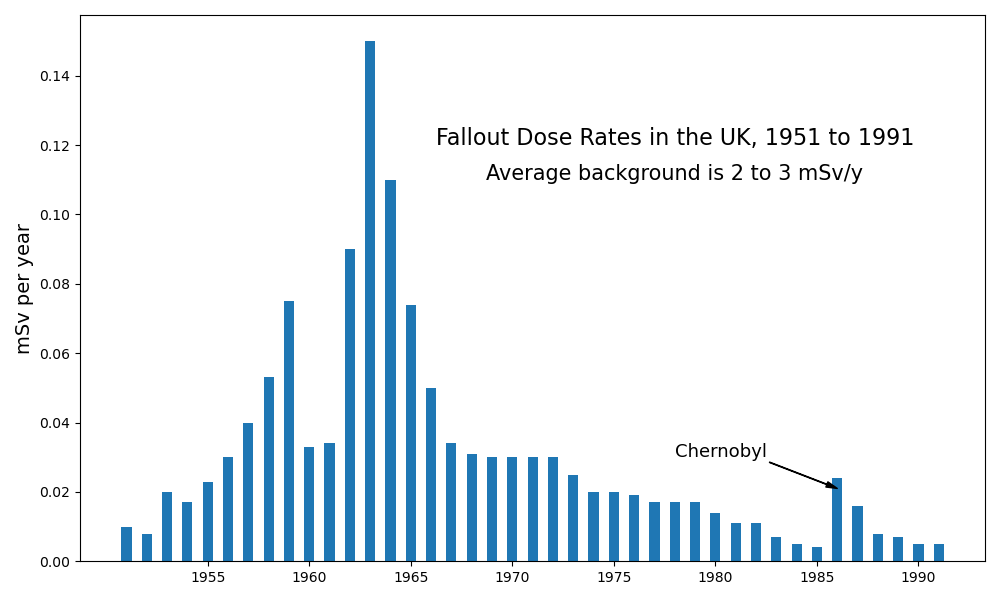
Figure 1. UK Fallout dose rates. The average background dose rate in Cornwall is 7.8 mSv/y.
The Rockefeller Foundation and its allies decided to argue that radiation produced genetic damage and that damage is unrepairable. Damage just keeps building up. Therefore, the harm is proportional to the total dose, regardless of how rapidly or slowly that dose is incurred. This is like saying taking 365 tablets of aspirin at once is the same as taking 1 tablet per day for 365 days. This no repair hypothesis is called the Linear No Threshold model or LNT.
If LNT is correct, then the Banners could aggregate the tiny increases in dose rate due to test fallout over hemispherical populations and over decades to argue that Bomb testing was invisibly killing millions of people worldwide. The Foundation expertly (and unscrupulously) promoted LNT with all its resources.
The MADers argued that banning the Bomb was politically impossible. Their solution was to make the Bomb so big and so scary that it would never be used. It was also in their interest to see LNT adopted. Their stance boiled down to: radiation is as extremely harmful as LNT claims; but that just means we need to make sure the Bomb is never used by making the weapon too horrible to use. Both sides needed to bash radiation, and bash it hard.
The Atomic Energy Commission(AEC) was in a bind. In 1954, Congress had given the AEC autocratic control over both nuclear weapons and nuclear power. The AEC had to both implement Mutually Assured Destruction, and promote and regulate nuclear power. Their quandary was captured by Karl Darrow, an important member of the Manhattan Project, who wrote to a colleague: “I take it that there are two main objects. One is to please the public with the prospect of beneficial uses of atomic power, and the other is to scare it out of its boots by threatening it with new weapons.”
The Foundation and it allies were successful.2 In 1959, the National Council on Radiation Protection, many of whose members were funded by the Foundation, recommended that radiation protection standards be based on LNT. In the same year, the AEC quietly adopted LNT. LNT became the law of the land.
LNT is biological nonsense
There was one problem. LNT is wrong. Our bodies do have the ability to repair radiation damage. The damage that we should be and are most concerned about is damage to our DNA. DNA is the part of the cell that contains the information we need to function. If that information is altered, a cell can go rogue and turn into cancer. Radiation damage can do just that.
But so can our own bodies. Humans are oxygen breathers. We combine oxygen with other chemicals to produce the energy we need to function. This is called metabolism. Our oxygen based metabolism allows us to do some pretty amazing things. But as a by product, we are constantly ripping up our own DNA. It turns out that our own internal metabolism produces over 25,000 times as many Double Strand Breaks as average background radiation. Double Strand Breaks are the kind of DNA damage that can lead to cancer.
Nature had to come up with a solution to this carnage. Otherwise we would not be here. Her solution was a panoply of usually very effective repair processes. Google ``DNA Repair’‘. Go ahead do it. You will get around 130 million hits. DNA repair has been studied in mind numbing detail. Three Nobel prizes have been awarded in the field of DNA repair. LNT’s foundational premise that radiation harm is unrepairable is flat wrong. This is indisputable.
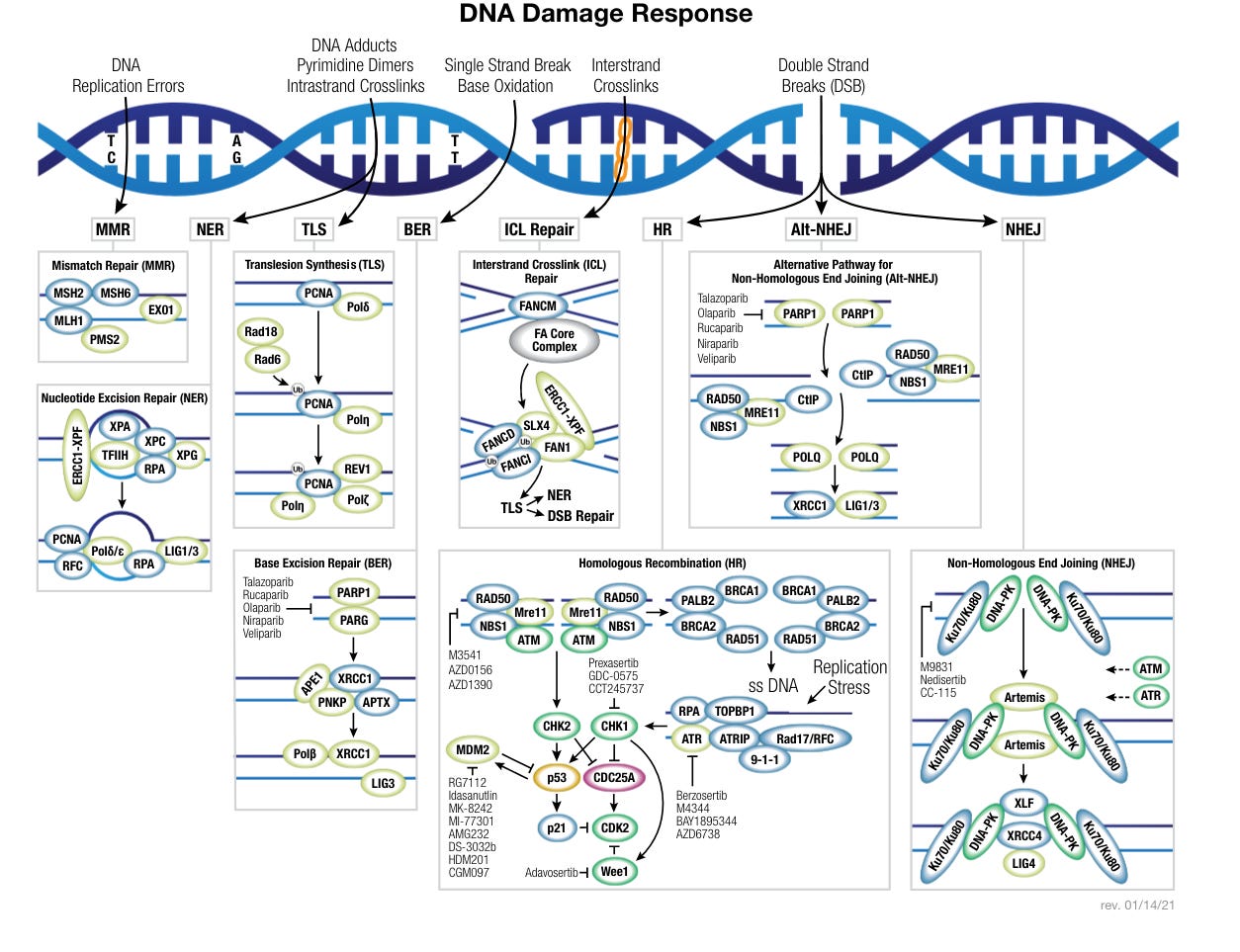
Figure 2. Super Simplified Diagram of DNA Repair Mechanisms
Radiation is a bit like aspirin. If we get a whole bunch of radiation at once, our DNA repair processes are overwhelmed, and we see an increase in cancer incidence. However if the radiation dose rate is not too high, our repair processes can keep up with the damage. In that case, we can detect no increase in cancer, even when that dose rate is incurred for decades.
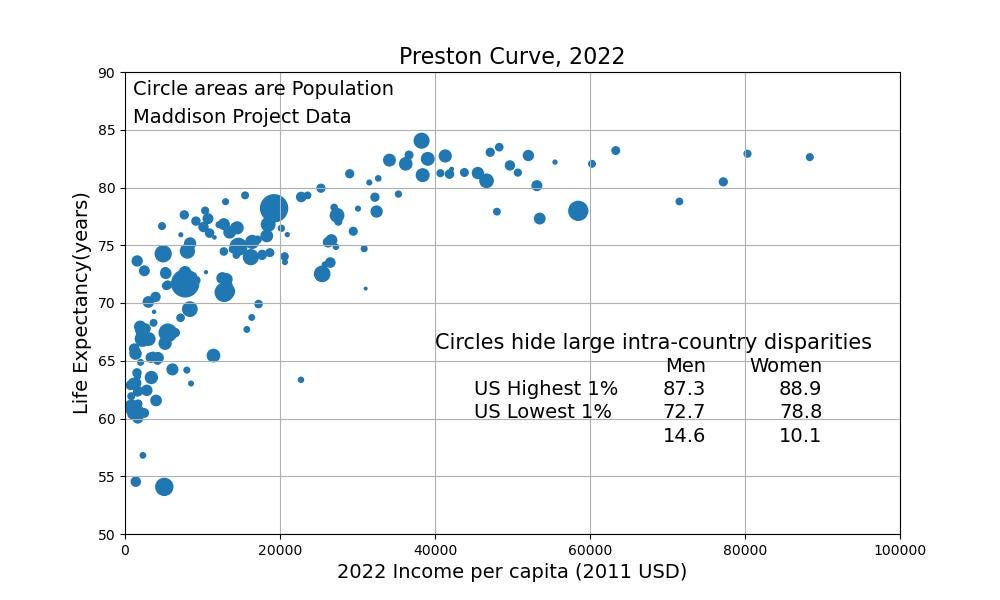
But why take any radiation risk at all? That’s an easy one. Humanity must have cheap nuclear power to flourish. That cheap electricity can make all humanity wealthier. The worst health hazard of all is being poor. Nothing else is close, Figure 3. Wealthier is healthier. By making nuclear power far more expensive than it should be, LNT is killing people.
Thanks to hundreds of millions of dollars of research, we have a pretty good idea what the dose rate is at which we start seeing an increase in cancer. Because our DNA repair processes must handle internal damage rates that are many thousands of times above background radiation damage rates, that dose rate is well above the dose rate that almost any member of the public will receive in even a release as large as Fukushima. In fact, we have detected no increase in cancer at Fukushima.\cite{unscear-2021}[p 106] Even at Chernobyl, the perfect experiment, the thousands of deaths confidently predicted by LNT have failed to materialize.\cite{leung-2019, zupunski-2021} We have detected no radiation induced harm to the public, other than thyroid cancer due to children drinking badly contaminated milk.3 This could easily have been prevented by confiscating the milk, as was done at Fukushima. In short, thanks to the remarkable DNA repair processes a providential Nature has bestowed on us, even a very large release will produce little or no detectable radiation harm to the public. The planet would be a far better place, wealther and healthier, with cheap nuclear and an occasional large release, then without both.
While LNT’s unrepairable predictions are roughly correct when a large dose is received all at once, LNT over-estimates the cancer incidence by factors of a 1000 or more when the same dose is spread over months and years, as it is in a nuclear power plant release. This has caused the radiophobia that both the Banners and the MADers intended. As a result we have turned control of nuclear power over to an autocratic, all powerful regulator who has been told a big release is an intolerable catastrophe. His overriding priority is preventing a release. The result is the current does-cost of nuclear power in the West is five or more what it did and can cost.
Nuclear’s Did and Can Cost
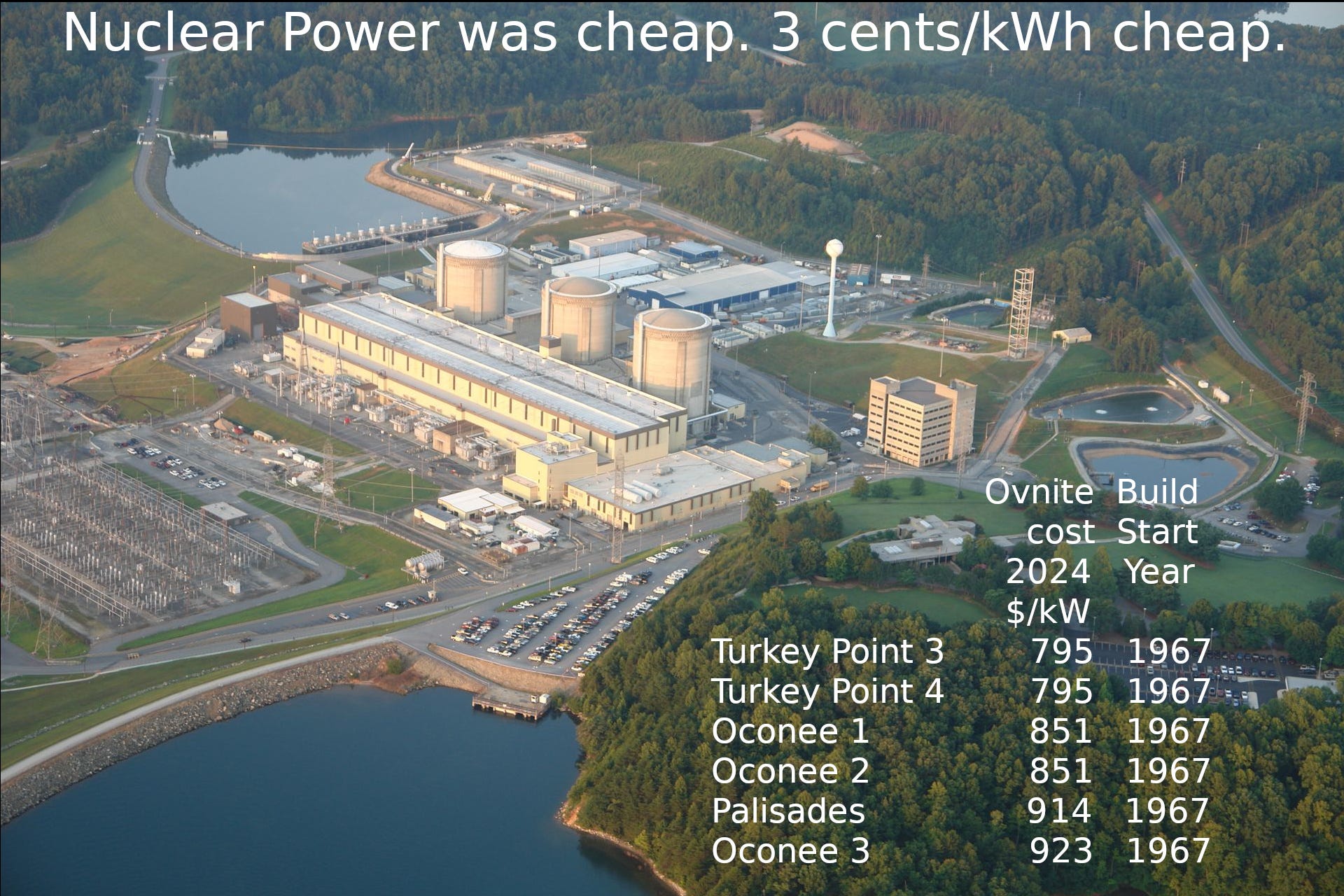
Figure 4. The 2500 megawatt Oconee plant in South Carolina. These three reactors were built for just over 350 million dollars between 1967 and 1974. That’s $1141 per kilowatt in 2024 dollars. They took about 6 years to build. Oconee can produce reliable, on-demand, zero pollution, very low CO2 electricity at less than 3 cents/kWh in today’s money. Oconee’s average capacity factor over the last 5 years was 98.2%. Oconee and its cooling pond Lake Keowee have turned a depressed part of western South Carolina into a second home and tourist magnet.
In the 1960’s, fission’s 100,000 to 1 advantage in energy density allowed nascent nuclear power, which was just starting down a steep learning curve, to go head to head with coal. In 1965, GE was able to show TVA that it would produce electricity for less than 3.7 mills per kilowatt hour.\cite{bupp-1978}[page 90] That’s about 3.2 cents per kWh in 2024 dollars. Komanoff, no friend of nuclear power, estimated nuclear’s 1971 CAPEX at 366 1979 dollars per kW, and coal without scrubbers at $346/kW.\cite{komanoff-1981}[p 20] Nuclear’s fuel cost advantage tipped the cost of electricity in favor of nuclear. In 1970, Paul Ehrlich, a determined foe of nuclear on Malthusian grounds, complained ``Contrary to widely held belief, nuclear power is not now `dirt cheap’. ... At best, both [nuclear and coal] produce power for approximately 4-5 mills per kilowatt-hour.”\cite{ehrlich-1970}[p 57] In the late 1960’s nuclear power was as cheap as coal, when coal was as cheap as it ever was in real terms.
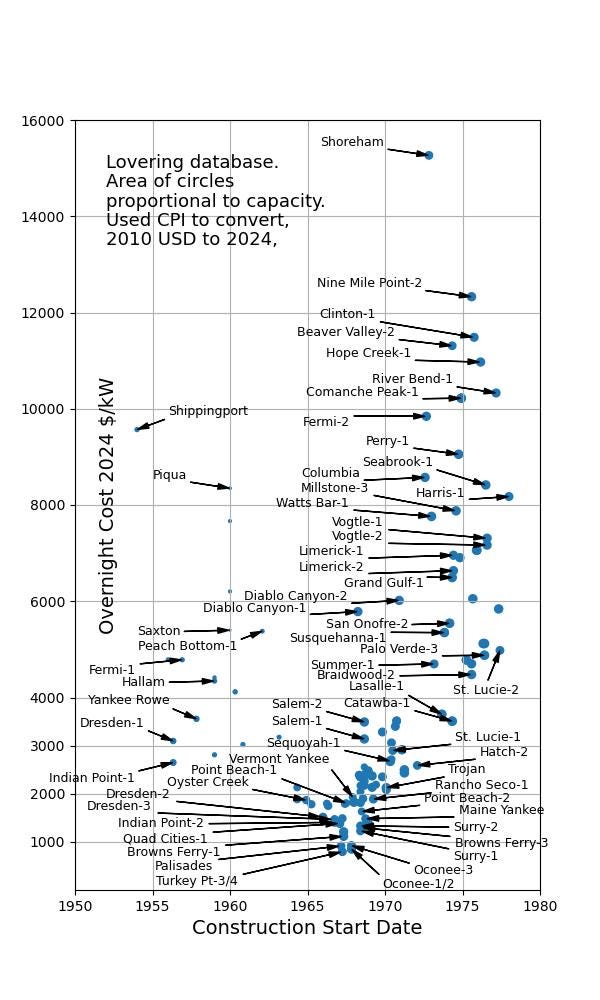
Figure 5. Overnight (no construction period interest) Cost, USA Nuclear Power Plants, adapted from \cite{lovering-2016}
This did not last long. Figure 5 shows the Overnight Cost of USA nuke plants built between 1950 and 1980 in 2024 dollars. The date shown is the date that construction started. Almost all the plants started between 1964 and 1968 came in at under $2000/kW in 2024 dollars. Six of those plants came in at under $1000/kW. See text in Figure 4. Five of them are still operating, and are licensed to the mid-2050’s. These early plants have been producing some of the cheapest electricity ever generated for more than 50 years, harming exactly zero members of the public in the process.
But by the mid-1970’s, the same size plants had an overnight cost of up to $10,000 2024 dollars and more with a very large scatter. Overnight costs are only a portion of the CAPEX. At the same time as overnight costs were skyrocketing, build times were doubling and tripling. Plants that took 4 years to build in the late 1960’s were taking 10 or more years in the late 1970’s. The 1970’s was a period of inflation and high interest rates. Construction period interest expense skyrocketed.
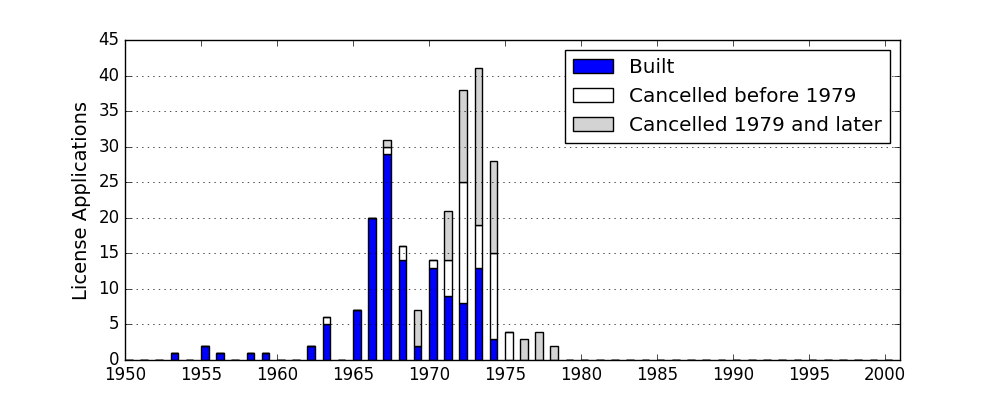
Nuclear quickly went from dirt cheap to prohibitively expensive. Few nuclear plants were ordered in the US after 1974, and all of those were canceled. This was five years before Three Mile Island, and in a period when public support for nuclear was more than 70%.
What happened? Through the 1950’s and early 1960’s, the real cost of oil was declining, reaching its all time low in 1967. The Majors were buying oil in the Mideast for a penny a liter. This forced coal prices down, and real coal price was also at an all time low in 1967, Figure 6.
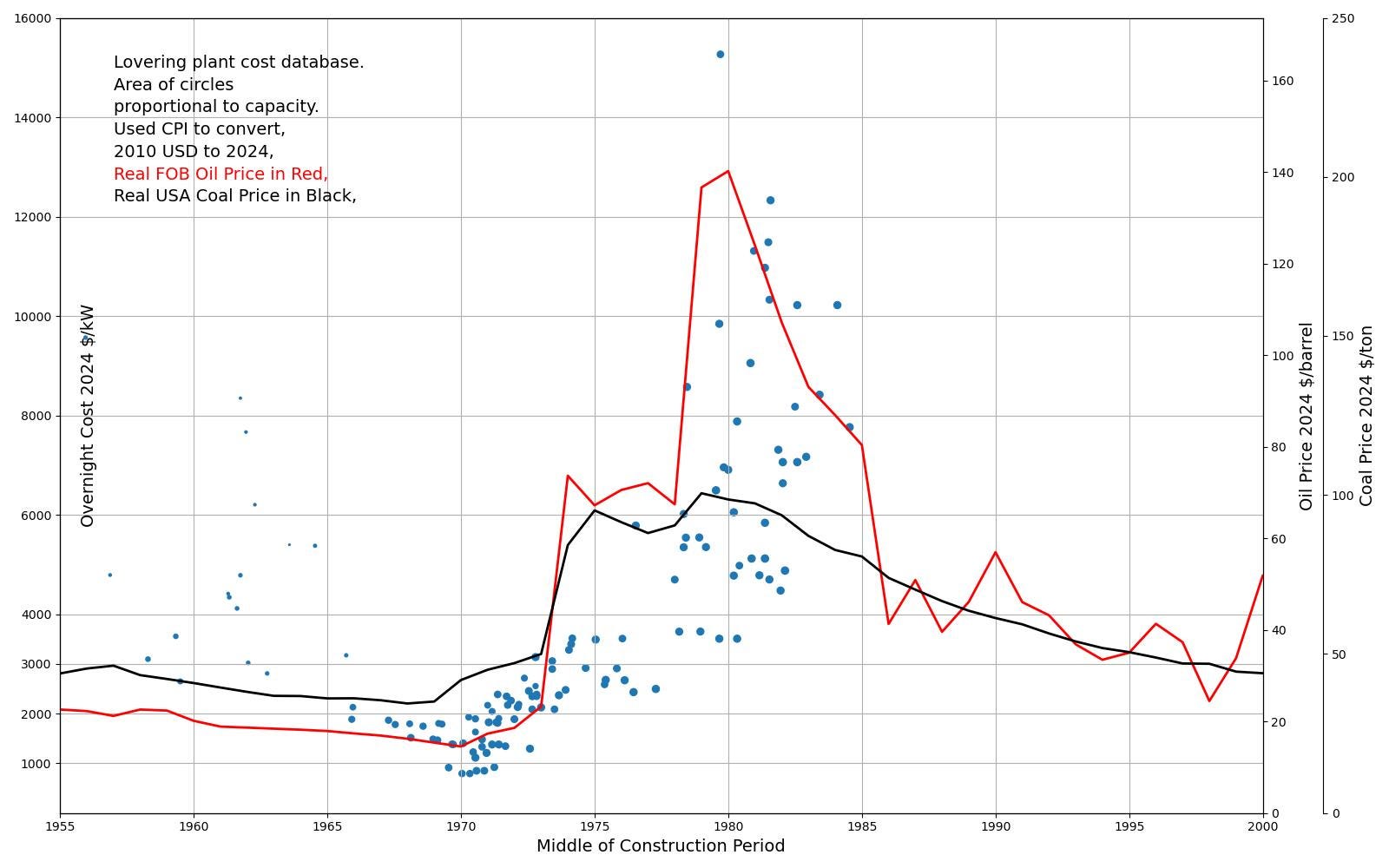
Figure 7. Fossil prices and USA nuclear overnight CAPEX. The oil price index is a little misleading. It’s an average of prices at the loading ports. The landed price jumped earlier due to the tanker market boom in 1967. You can see that in the US coal prices.
But in June of 1967 the Six Day War closed the Suez Canal. The extra ton-mile demand for tankers sent the tanker market into boom, and the landed cost of oil in the West doubled. The Canal closure showed the utilities how vulnerable oil was. They started scrambling to build coal (and nuclear) plants. It was a smart move; but in the next few years fossil was hit by one blow after another. The nationalization of Libyan oil in 1969 led to leap frogging oil prices, culminating in the Oil Crisis of 1973 brought on by the Yom Kippur war. At the same, coal was blasted with a slew of new pollution regulations. The unions piled on as the UMW recognized labor now had massive bargaining power. Coal suffered a series of costly strikes, both union and wildcat.
All this should have been great news for the new guy on the block, nuclear. Nuclear was insulated from both oil price and fossil pollution regulation. But nuclear’s costs rose in lock step with coal’s. Bupp and Derian’s Light Water is the standard history of early American nuclear. These authors were befuddled:
Coal seemed to be just competitive with nuclear power from light water reactors at about 25 to 30 cents/mbtu in 1970; it still seems to be competitive at about four times that price in 1976.\cite{bupp-1978}[page 97] [Emphasis in the original.]
They need not have been. In 1967, a new omnipotent player had emerged. In 1954, Congress had given the AEC complete and unfettered control over nuclear, both nuclear weapons and nuclear power. As Truman put it, atomic power was “too important to be made the subject of profiteering”.\cite{ford-1982}[p 41] The AEC had to both implement Mutually Assured Destruction, and promote and regulate nuclear power.
Prior to 1961, the Nuclear Power Regulatory Division was just another box in the AEC organization chart, reporting to the General Manager, who had to balance nuclear power’s risk and cost in exercising the AEC’s autocratic power. Here’s how Irvin Bupp described this period.
At first, the AEC simply never took the job of regulating nuclear power seriously. Regulatory policy was explicitly based on the peculiar proposition that because nuclear technology was so obviously hazardous, the companies manufacturing and purchasing it would regulate themselves. \cite{bupp-1985}[p 1968]
No, Irvin there was nothing “peculiar” about this system. This is the system that gave us the Turkey Points and the Oconees. If the plant owners have to pay for any harm they cause, they will find the right balance between cost and risk
But in 1959, the AEC had quietly adopted Linear No Threshold(LNT) hypothesis, a radiation harm model that claims our bodies cannot repair damage to our DNA, a claim that denies indisputable biology. The AEC did this in part because it heightened fear of the bomb. But LNT also massively magnified the fear of a nuclear power release. In 1961, the Regulatory Division was split off from the rest of the AEC. It now reported directly to the Commissioners. The Division’s job was to prevent a release. Period. Cost was not a consideration.4
The only limit to this unbridled, dictatorial power was the cost of fossil. If the Division pushed the cost of nuclear above the cost of fossil, license applicants would disappear and the Division would have nothing new to regulate. After 1968, it would also lose the revenue from the application review fees, on which it was dependent. As the cost of coal rose, the Regulatory Division quickly pushed nuclear’s cost up against the new limit.
With the doubling and tripling in coal prices between 1967 and 1975, the utilities’ goal became do whatever you have to do to get nuclear plants built. Rather than pushback against new regulations, no matter how silly or superfluous, and engage in time consuming negotiations, the utilities decided to accept anything they thought they could pass on to the ratepayer.
Congress has explicitly given the AEC not only the power to make the rules but to change those rules as it saw fit. Regulatory uncertainty made fixed price contracts impossible. The last turnkey contract was signed in 1968. But there was an out. In this period, all the US utilities were regulated monopolies. By signing cost plus contracts, the vendor transferred the regulatory risk to the utility, and the utility transferred the risk to the ratepayer. A regulated monopoly is a system in which the more money the utility spends, the more money the investors make. The incentives are all wrong. Costs and build times explode. But the regulators are happy; the vendors are happy; the investors are happy; and the ratepayers are screwed.
Over time most of the Western countries have adopted something similar to the American system. The results have been predictably horrible. Current newbuilds in the West cost more than $15,000 per kW (ten times the cost of Oconee and her sisters in real terms) and have construction times of more than ten years. The strike price for Hinkley Point C is an impoverishing 133 pds/MWh (18 cents/kWh). By denying our ability to repair DNA damage, we have effectively rejected the blessings of nuclear power.
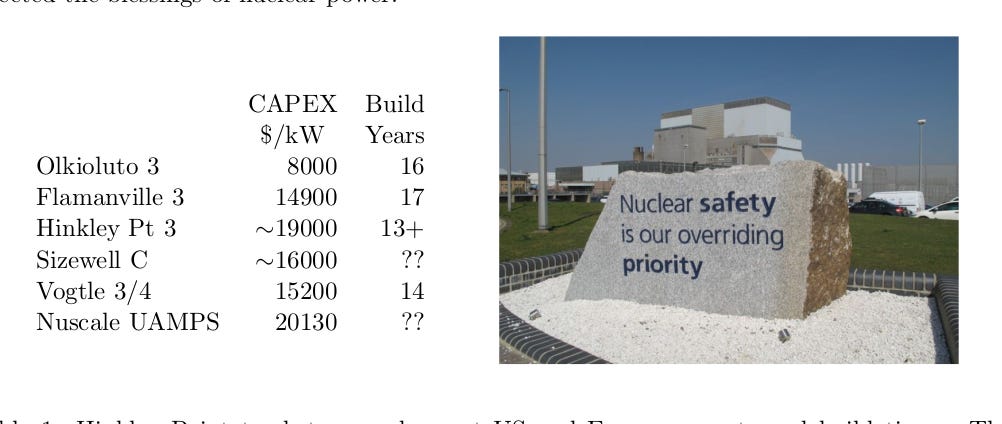
Figure 8. Hinkley Point tombstone and recent US and European costs and build times. The inscription is wrong. Human welfare is our overriding priority. Suppose you told a football team: Guys, your overriding priority is not getting hurt. If any of you get hurt or do anything that might get you hurt, you are out of football for life. Now go out there and win this game. How well do you think that team would perform?
Enlightenment and Action

1) Nature has provided us with a source of electricity with a energy density that is 100,000 times that of fossil. A source that requires little land, and produces almost no pollution and no CO2. A source that was and can be cheaper than coal, much cheaper. It’s called nuclear fission.
2) Nature has provided us with a DNA repair system that can handle the unique hazard associated with this source. She had to do this to protect us from our own oxygen based metabolism.
You can call this double gift, providential. You can call it, anthropic. You can call it, dumb luck. But what you don’t do is reject it. By denying the second gift, humanity has rejected the first. This is an act of auto-genocide.
In Hindu theology, Lakshmi is the Goddess of wealth and prosperity. Ganesh is the God of wisdom and the remover of obstacles. The basic idea of pairing them, as I understand it, is receiving a fortune doesn’t mean much unless we have the knowledge to use it wisely. I think all of us can agree there is a lot of wisdom in that precept.
It is certainly true when it comes to nuclear power. Nature provided us with a source of electricity that would have been unimaginable 100 years ago. That source has an energy density 100,000 times larger than fossil fuel. That means it requires very little of the planet’s precious resources. In a syllable, it can be cheap. And in fact nuclear power was cheap, 3 cents/kwh cheap in today’s money when it was still moving down a steep learning curve in the late 1960’s. On top of that, fission power uses up little land, and produces almost no pollution and very little CO2. It is hard to imagine a more bountiful gift.
And that’s only half the blessing. Fission like electricity and high pressure steam and fire itself comes with a unique new hazard: RADIATION. But Lakshmi, Nature, evolution --- I don’t care what we call it --- doubled down. She not only gave us fission; she also provided us with a DNA repair system that can easily handle dose rates hundreds of times above background, dose rates that are unlikely to be exceeded by any member of the public in even a very large release.
What she did not give us was the knowledge to use this double gift wisely. In fact, due to the ominous way fission power came to us, we chose to massively exaggerate the harm associated with radiation, in order to decrease the probability of the Bomb being used again. This led to the Intolerable Harm Lie, a big release of radioactive material would be so catastrophic that it cannot be permitted to happen.
Therefore, we gave control of nuclear power to an all powerful, purblind regulator, whose overriding priority is preventing a release. In the NRC’s world view, making people poorer is unimportant. Global warming is not their business. Harm from alternate sources of electricity is not a consideration. Evacuation and exile costs can be disregarded. The only thing that counts is radiation harm, based on a harm model that is biological nonsense.
As a result nuclear power in the West now costs five or more times what it can and did cost. What should be our cheapest source of electricity is impoverishingly expensive. By denying our indisputable ability to repair DNA damage, we have effectively rejected the blessings of nuclear power.
That’s where Lord Ganesh must come in. We need him to give us the wisdom to recognize and accept the second half of the blessing. But we need more than wisdom. We need action. Ganesh is depicted holding a lotus and an axe. The lotus represents enlightenment. In this case, the recognition that we have been lied to and the rejection of that lie. The axe represents Ganesh’s role as the remover of obstacles. Sixty years of universal acceptance of the Intolerable Harm Lie has created a coven of very powerful special interests whose existence depends on that Lie. We will need a very big axe to remove those obstacles.
For the full story and replacements for both LNT and the current auto-genocidal regulatory system, get the Humanity has been Twice Blest book.
Almost all of the death and injury was due to the direct effects of the blast. Shock wave and heat. At least 150,000 people have been killed by the two bombings. The Japanese/American Radiation Effects Research Foundation attributes 942 of these deaths to radiation caused cancer over the subsequent 70 or more years.
Despite the fact that even then there was all sorts of empirical evidence that LNT was false. Multiple violations of scientific integrity were required to push LNT through. Some of this was careerism; but the primary reason the scientific community accepted a theory that they must have known was wrong was fear of the Bomb.
The milk was contaminated with radioactive iodine. Iodine concentrates in the tiny thyroid gland. This concentration multiplied the dose rates that these kids’ thyroids incurred by over a factor of 1000. The one thing we must do in a release is prevent this from happening. But that is not difficult, in part because radioactive iodine disappears in about ten weeks.
In 1979, the NRC shut down five East Coast nuclear plant taking 4 GW of power offline during the middle of the Iranian Oil Crisis after a bug was discovered in the NRC approved design software. The shutdown cost the US consumer at least 350 million 1979 dollars and still longer gas lines. The error might have resulted in a pipe support failure but only if the plants experienced the largest earthquake on record for the area. The NRC Chairmen Hendrie told the Senate that no attempt had been made to estimate the cost of the shutdown because the NRC’s responsibility was nuclear safety “without regard to economic and social costs”.
Can you clarify my understanding of figure 1. It says "UK fallout dose rates" -- which I assume to be reasonably constant over the entirety of the U.K. To get the total dose rate at a location in the U.K. one would have to add the local background dose rate. In Cornwall in 1963, we would add the fallout dose rate of 0.15 mSv/yr to the background dose rate of 7.8 mSv/yr
Maybe 60 Minutes on new CBS.